
The past twelve days have been…they have been. I’m alive. Finished the #Vipassana #Meditation course. Cheers to continued self work. #BePeace #Goa #India #SelfDiscovery #Dhamma #COS

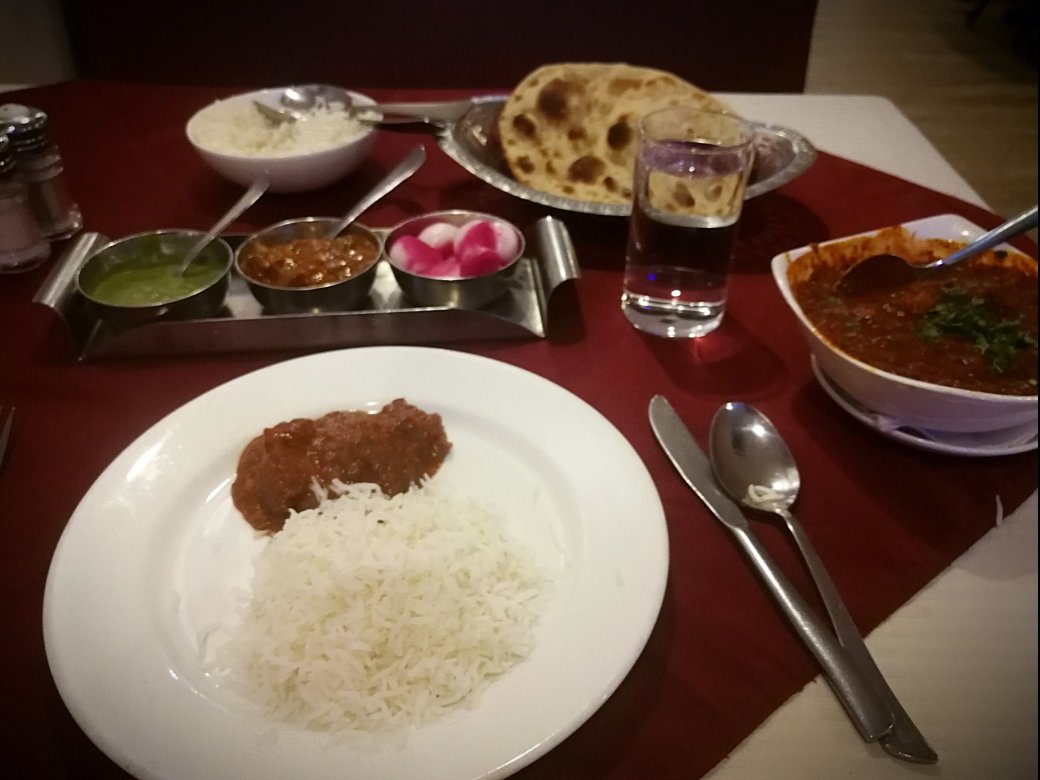
Language. Food. Culture. The first two usually have huge influence on the third. While I haven’t learned Konkani (the language of the state), I have taken the opportunity to experience the cuisine. One of the traditional Goan dishes is vindaloo. It’s a red curry sauce with meat. Historically, that meat has been pork, but vindaloo can be ordered with mutton or chicken as well. Everything that I had read made a point of noting how spicy vindaloo is. People warned me in various conversations. I always responded the same. I appreciate and welcome spice. The picture above is of some mutton vindaloo that I had for lunch one day in Panaji. The dish was extremely tasty and flavorful. It was also extremely hot. The following is my stream of consciousness while I ate the mutton vindaloo:
I like spice. I like spicy. This is another level. There are probably fires that don’t burn this hot. My mouth is still cooling down. This spice was intense as fuck. Why am I sweating so much? Like my eyes are watering and my internal body temperature is probably a few degrees higher now. Why does my stomach feel warm? This is not going to good to the toilet gods.
Be kind to yourself.
Onward.

So far in India, I’ve been to two places: Mumbai and Goa. While Mumbai is in the state of Maharashtra, Goa is a state on its own comprised of several small cities and villages. While moving around Goa can be done by bicycle, motor bike, or taxi among other modes, moving around Mumbai presents several options. In addition to trains, buses, and taxis, there’s the auto rickshaw.
I should note that auto rickshaws are present in Goa as well, at least in Mapusa and Panaji. They just aren’t as popular as they are in Mumbai. When I needed to find one in Mumbai, I could (after going to different ones to find one to take me). The auto rickshaws in Mumbai are metered, starting at a base fare of 18 rupees and increase accordingly for distance and time spent waiting in traffic (which there is an abundance of). I was told that there is a night surcharge, which starts at a base fare of 24 rupees. I’m not sure what time the night surcharge starts. I travelled a few nights after 11 PM, and was not charged a night rate. For a ride of five kilometers, I paid around 75 rupees (just over $1 USD). In the south Mumbai region, auto rickshaws are not allowed so options are limited to trains, buses, taxis and walking.
To contrast Mumbai’s auto rickshaws, the same transport in Mapusa and the rest of Goa do not use meters. Prices are “negotiated” before riding. For a ride of ten kilometers, I paid around 220 rupees (which was negotiated down from 300 rupees). The picture above was taken from a bus window while sitting in Mumbai traffic.
Be kind to yourself.
Onward.


I love food. Especially good food. It’s one of my main reasons for traveling to new places. Street food is an exceptional favorite. Walking around to take in the sights and sounds gets enhanced by the smells. Since I arrived in India, I have learned that most of what the western world eats as Indian food comes from northern India. As a very large country with different cultures, languages, and people, Indian cuisine is more than curries, biryani, and naan. Each of the states have their own culinary traditions.
Since arriving in India a little more than a week ago, I have kept my eyes and nostrils open for potential street food adventures. The collage above features some of the street food I ate during my first week in Mumbai. While roaming the city, I try to notice street food places where many people are congregating. Though not always true, popular can insinuate good taste.
In the top left is a dish that I can’t remember the name of, but it is traditional served as breakfast in Mumbai and surrounding regions. The sauce is soupy and spicy, but the spice is a slowly building, subtle spice. Moving clockwise, this snack is known as vada pav. A roll is spilt to allow a spicy chutney and a dab of other chillies to put on the bread. The roll is then filled with fresh, hot fried potatoes that have been coated in a light batter. This roll was exceptionally delicious. Continuing clockwise, this is a dessert/snack and I’m not sure of its name. It’s some kind of fried dough and it’s extremely sweet. Like biting into concentrated sugar. It reminded me of the South African dessert, koeksister. Lastly, there’s the amul dabeli. It’s a small sandwich that starts with some spicy chutney spread on the bun. There’s a mixture of stuff that goes into the sandwich filling including a spicy potato mixture, pomegranates, and cilantro. It’s a decadent mix of spicy and sweet without being too much of either. So far, this might be my favorite of the street foods that I have experienced.
Be kind to yourself.
Onward.
Guest Post Note: Most of this blog has given you my experience in Peace Corps eSwatini. This week, here’s something a little different. How did Peace Corps eSwatini, through the lens of a PCV, experience me? Meet Lakia. She is currently serving an extension year as a PCV in Peace Corps eSwatini. She enjoys reading, travel, blerd culture and being the greatest aunt ever. Find her on twitter – @pirate_jenn

Kirby P. Riley and I met 2 years and 2 months ago. Well, not really met. More like I tried to greet him on the airport shuttle, he wasn’t interested, I retreated to my own personal space and we carried on from there. But over the span of 2 years and 2 months, I’ve come to completely love and
learn so much from this genuine, kind, slightly anti-social gentleman.
I wish I could sum him up in a neatly bound collection of quirky adjectives and anecdotes, but I can’t. He’s just Kirby. Full stop. Anyone who knows him, knows that this phrase is enough. They understand that there is no box that works, no paragraph that can bind such a fluid individual. All
that I have, all that anyone who knows this weirdo has, is a bunch of interesting experiences so cherished that they simply can’t be shared with just anyone.
Like the times when we traded stories about our work as educators in our respective communities. Kirby is the most dynamic, long-winded storyteller I’ve ever met. But it works, somehow. Because he’s Kirby. Or the times at every Peace Corps training when a guest speaker is present and he has a question. Every question, everywhere, is always prefaced with “Uhhhhhh….hello….Kirby P. Riley,
what-is-kirby-doing-dot-com…..soooo, so my question is….” That’s Kirby. Full stop.
At a glance, he could seem like an aloof individual. But after a range of debates, puzzling Peace Corps moments, crying on his shoulder, and chats into the evening, I have learned he is immensely present. He is there. When you think he might not be paying attention. When you think you only have him as a random colleague in your life. He will show up and surprise you in profound ways. He will stretch your values and demand you know who you are and what you’re talking about. As a true friend does. Full stop.
Kirby P. Riley refuses to be my housemate. Something about “I’ll annoy him forever”, blah blah blah. But regardless, he’s stuck with me. Because like Kirby, while I don’t know everything, I know what matters. Which is when you find something good, something that moves you and helps you grow, you hang on to it. Like the Cowboys, and Reddit, and the Burn, and good soul food and sweet tea. Like our friendship. So sadly, he will find me in lots of places – on the phone, in his emails, his blog posts (but Reddit is where I draw the line, because that place scares me).
Anyone who knows anything about Peace Corps would assume that working in such an organization is trying work that tests your limits. You have to step into the capabilities you are made of. Those assumptions are correct and then some. What I found to be a saving grace in my service has been the connections with those around me who understand the layers of this work and can encourage me while I navigate the complexities of Peace Corps service. Those connections are ones I am deeply grateful for, ones that have changed my life forever. And one of those connections came in the form of a guy filled with heart, soul, compassion and an ear-splitting cackle.
Kirby. Full stop.
Be kind to yourself.
Onward.

Today, I moved out of my home in a rural southwestern nook in eSwatini. Later this week, I will officially finish my service to the kingdom of eSwatini. Similar to entering service, there will be meetings and paperwork
At school last week, I gave a farewell speech to the student body. Following my speech, one of our senior students spoke on behalf of the learners to thank me for all that I’ve done at the school. Some students gave written notes of gratitude. It’s amazing to know that the students are always listening, watching, and learning.
On my final day at the school, my school co-workers organized a farewell lunch for me. There were speeches as we enjoyed one of my favorite Swazi street foods, chicken dust. The staff presented a t-shirt they had made for me. On the front is a black and white photo of me eating a piece of meat. I was told that the reasoning for this was because I have introduced myself around the community on numerous occasions saying, “Nginu Sibusiso. Ngiyatsandza inyama”, which means “I am Sibusiso. I like meat”. On the back of the shirt, it has my Swazi name (Sibusiso) at the top, “eSwatini KuseKaya” meaning “eSwatini is home” in the middle, and my blog signature at the bottom.
I am thankful to have joined such an amazing core of teachers. The above picture was taken by one of our students after the farewell luncheon and features many of the teachers from our local high school.
Be kind to yourself.
Onward.

When it comes to grocery stores, there are a few options around eSwatini. In the southwest town of Mankayane, there are a few grocery stores. These are smaller, independent grocery stores. Around eSwatini, there are four large chain grocery stores including Shoprite, Pick n Pay, Spar, and Boxer. There’s a smaller version of Shoprite in some places called U-Save. Some cities have a Super Spar. All four large chain grocery stores will typically have a bakery, a butcher, and a hot food bar.
I tend to do most of my shopping at Shoprite for a couple of reasons. First, they have many locations, especially in the places I frequent in eSwatini. Second, it’s cheaper than some of the other grocery options, for the things I buy. Third, there are some products I love that are only available at Shoprite including the store brand oats and Frimax’s Sweet Chili potato chips. I think Pick n Pay has the best hot food bar with Spar running a close second. Spar’s bakery features fresh made doughnuts, which are absolutely delicious. If the store sells alcohol, it’s typically done in a separate, lockable, section of the grocery store or it’s a separate store all together. The above picture was taken outside of the Shoprite entrance in Ezulwini.
Be kind to yourself.
Onward.
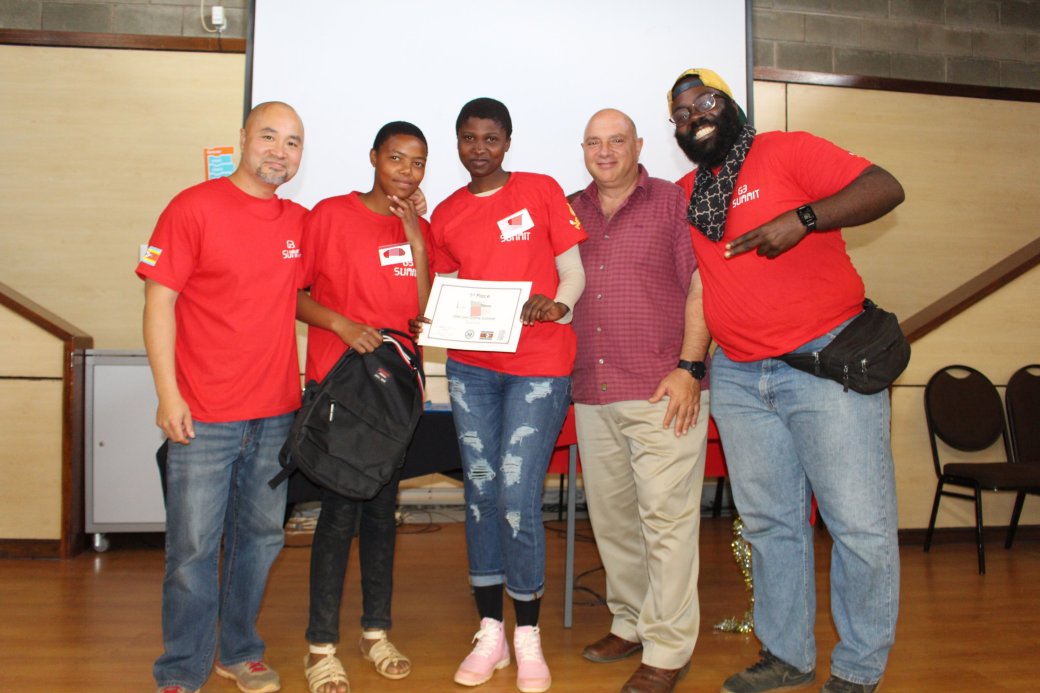
In December 2017, fellow eSwatini PCV Deacon hosted a camp to teach girls and young women how to code using Scratch, the visual programming language. This past Saturday, he hosted a Scratch Day competition. The students returned to central eSwatini to showcase their cartoons and video games in competition. The theme given for the competition was solving a problem in eSwatini.
More than thirty students represented GLOW clubs from all over the country. While the cartoons and video games weren’t being judged by panels from Women in Engineering (of eSwatini), students participated in discussions about women and girls in STEM after watching a TED talk from Dr. Knatokie Ford. In another room, students were invited to explore electric circuits in unconventional ways among other things. The students also has the opportunity to participate in a typing competition.
I am happy to report that our students placed third in cartoon design, and won the video game design competition. Their video game featured a girl catching falling good advice and avoiding falling bad advice. Catching good advice granted the player one point while catching bad advice subtracted a point from the player’s score. For their efforts, they won a tablet, backpacks, and a laptop. The above picture shows Deacon (the man behind G3 and Scratch Day), my Scratch-coding students (from our local high school), Mike (the Deputy Chief of Mission to eSwatini), and me.
Be kind to yourself.
Onward.

I love thrift stores. There’s some magical about spending copious amounts of time looking through any and everything. My mother said that I get this trait from my grandmother, who also loved thrifting. Shortly after arriving in eSwatini, I found Thelma who owned a small thrift store in Manzini, eSwatini’s biggest city. Thelma spruced up my wardrobe with a few items. Due to rising business costs, Thelma had to close her store.
Some PCVs in the prior groups told me about a wonderful swap meet known as Bend and Pick. Every Wednesday and Thursday (excluding some Swazi public holidays), vendors from eSwatini and the rest of southern Africa converge on the Manzini bus rank with their wares. Bend and Pick is the largest regular flea market, that I know of, in eSwatini. If it can be worn, you’ll probably find it there. I’ve found several gems there including my super useful fanny pack. The prices are reasonable, even on a PCV budget. I’ve found that prices tend to be better the deeper you go into the market. Unlike most places in eSwatini, you can negotiate at Bend and Pick. Like thrift stores, Bend and Pick is not for folks who are in a rush or impatient. I’ve also found that as a man of size, Bend and Pick tends to be better for finding clothes that fit me. The picture above is from Bend and Pick a few weeks ago.
Be kind to yourself.
Onward.
 What is Kirby Doing?: Stories from life after Peace Corps eSwatini