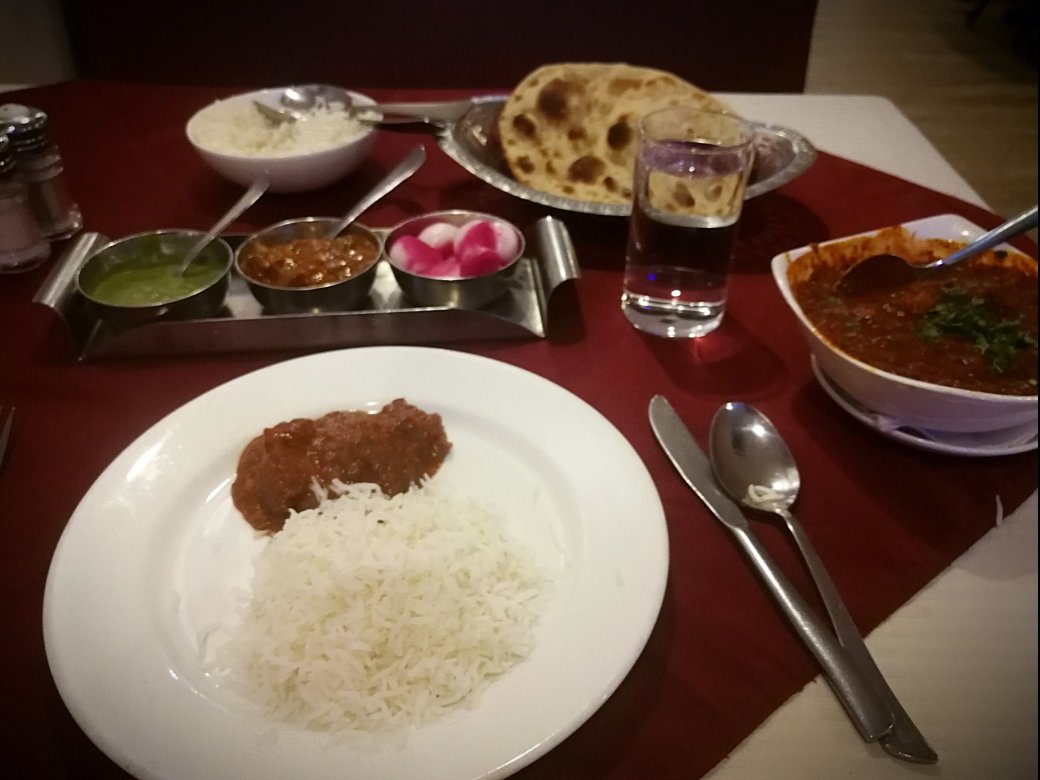
Monday in a Picture – Vindaloo

Language. Food. Culture. The first two usually have huge influence on the third. While I haven’t learned Konkani (the language of the state), I have taken the opportunity to experience the cuisine. One of the traditional Goan dishes is vindaloo. It’s a red curry sauce with meat. Historically, that meat has been pork, but vindaloo can be ordered with mutton or chicken as well. Everything that I had read made a point of noting how spicy vindaloo is. People warned me in various conversations. I always responded the same. I appreciate and welcome spice. The picture above is of some mutton vindaloo that I had for lunch one day in Panaji. The dish was extremely tasty and flavorful. It was also extremely hot. The following is my stream of consciousness while I ate the mutton vindaloo:

I like spice. I like spicy. This is another level. There are probably fires that don’t burn this hot. My mouth is still cooling down. This spice was intense as fuck. Why am I sweating so much? Like my eyes are watering and my internal body temperature is probably a few degrees higher now. Why does my stomach feel warm? This is not going to good to the toilet gods.

Be kind to yourself.
Onward.

Where Did My Money Go?

Budgets are important. Time, money and other resources are finite so the absence of an accountability method can lead to a very quick draining of those resources. In the age of technology, mobile apps have made it easier. For my COS trip, I was looking for an app that could handle budgeting and expense tracking using multiple currencies.

After some internet searches, I came across Toshl. It can track income and expenses while handling budgeting tasks. The app allows you to set a home currency, while entering expenses (or income) in other currencies. It will automatically show conversions to the home currency at the last updated rate. For example, I can set my home currency to the US dollar and enter Kenyan expenses in Kenyan shillings after entering Swazi expenses in Swazi emalangeni. In my expense tracker, the expenses will show in their respective currencies with the day’s exchange rate for US dollars. The app has premium, paid features that I have not explored. One such feature is the ability to connect bank accounts for automatic syncing.

Overall, the app has been just what I needed. It has allowed me to keep track of my spending during trip. It even reminds me, via mobile notifications, to ensure that I input all of my expenses. Recently, I even got a notification that I’m on track to be slightly under budget (for my trip). I would recommend it if you’re planning on traveling abroad or dealing in currencies outside your home currency.

Be kind to yourself.
Onward.

Monday in a Picture – Auto Rickshaw

So far in India, I’ve been to two places: Mumbai and Goa. While Mumbai is in the state of Maharashtra, Goa is a state on its own comprised of several small cities and villages. While moving around Goa can be done by bicycle, motor bike, or taxi among other modes, moving around Mumbai presents several options. In addition to trains, buses, and taxis, there’s the auto rickshaw.

I should note that auto rickshaws are present in Goa as well, at least in Mapusa and Panaji. They just aren’t as popular as they are in Mumbai. When I needed to find one in Mumbai, I could (after going to different ones to find one to take me). The auto rickshaws in Mumbai are metered, starting at a base fare of 18 rupees and increase accordingly for distance and time spent waiting in traffic (which there is an abundance of). I was told that there is a night surcharge, which starts at a base fare of 24 rupees. I’m not sure what time the night surcharge starts. I travelled a few nights after 11 PM, and was not charged a night rate. For a ride of five kilometers, I paid around 75 rupees (just over $1 USD). In the south Mumbai region, auto rickshaws are not allowed so options are limited to trains, buses, taxis and walking.

To contrast Mumbai’s auto rickshaws, the same transport in Mapusa and the rest of Goa do not use meters. Prices are “negotiated” before riding. For a ride of ten kilometers, I paid around 220 rupees (which was negotiated down from 300 rupees). The picture above was taken from a bus window while sitting in Mumbai traffic.

Be kind to yourself.
Onward.

Monday in a Picture – Mumbai Street Food

I love food. Especially good food. It’s one of my main reasons for traveling to new places. Street food is an exceptional favorite. Walking around to take in the sights and sounds gets enhanced by the smells. Since I arrived in India, I have learned that most of what the western world eats as Indian food comes from northern India. As a very large country with different cultures, languages, and people, Indian cuisine is more than curries, biryani, and naan. Each of the states have their own culinary traditions.

Since arriving in India a little more than a week ago, I have kept my eyes and nostrils open for potential street food adventures. The collage above features some of the street food I ate during my first week in Mumbai. While roaming the city, I try to notice street food places where many people are congregating. Though not always true, popular can insinuate good taste.

In the top left is a dish that I can’t remember the name of, but it is traditional served as breakfast in Mumbai and surrounding regions. The sauce is soupy and spicy, but the spice is a slowly building, subtle spice. Moving clockwise, this snack is known as vada pav. A roll is spilt to allow a spicy chutney and a dab of other chillies to put on the bread. The roll is then filled with fresh, hot fried potatoes that have been coated in a light batter. This roll was exceptionally delicious. Continuing clockwise, this is a dessert/snack and I’m not sure of its name. It’s some kind of fried dough and it’s extremely sweet. Like biting into concentrated sugar. It reminded me of the South African dessert, koeksister. Lastly, there’s the amul dabeli. It’s a small sandwich that starts with some spicy chutney spread on the bun. There’s a mixture of stuff that goes into the sandwich filling including a spicy potato mixture, pomegranates, and cilantro. It’s a decadent mix of spicy and sweet without being too much of either. So far, this might be my favorite of the street foods that I have experienced.

Be kind to yourself.
Onward.

Yo Taxi!

There’s a running joke truth that a Black man (in America) can’t get a cab. For me, that’s rarely the experience but friends and other Black folks have experienced this first-hand, on a regular basis. I’ve been in Mumbai for a few days now. It’s a culture shock in many ways. There are around 18 million people in this city. It’s the most populous city in India, and one of the most populous in the world. There are many languages being spoken including Hindi (a national language) and Marathi (the state language for Maharashtra, where Mumbai is). The food is jumping with various spices and flavors. The traffic is busy. Crossing the street is an exercise in physics calculations and wishful thinking. Nevertheless, I digress.

To get around everywhere in Mumbai (outside of South Mumbai), many people use rickshaws. They get you where you need to be relatively quickly. More of them can fit on the congested streets. They’re perfect for city travel around Mumbai. On a few occasions now, I’ve approached a rickshaw driver to get transport to my destination. Some drivers shake their head to say no, while others verbally say the same. I don’t know if it’s more of the same “Black man can’t get a cab” type racism or if people would rather not deal with a foreigner who doesn’t really know the city nor the language(s). In the mean time, I’m trying to learn some of the local languages, so that I can communicate with drivers. We shall see.

Be kind to yourself.
Onward.