Monday in a Picture – Spotlight

For the second (or third, depending on how you count) time this year, I have been the main subject of a write-up in the Times of Swaziland. In January, there was an article about Parkrun, in which I was briefly interviewed. In February, the Times of Swaziland featured an article about the excitement I caused (among older women) as a super hairy umbutfo (pronounced oom-boot-foe), or warrior. Last Thursday (5 July 2018), the article pictured above was featured in the Times of Swaziland. In all instances, I received messages (from Peace Corps affiliated folks) alerting me to the write-ups. Unlike the other instances, I didn’t talk anyone from the newspaper so I wasn’t expecting this. The article did come after a post about my work was published on the Peace Corps eSwatini stories page on 3 July 2018.

My hope is that Wikipedia Offline (and Kiwix) get the much deserved attention, and that more schools, NGOs, and other organizations begin to use these products to unlock untapped potential.

Be kind to yourself.
Onward.

Monday in a Picture – The Mural

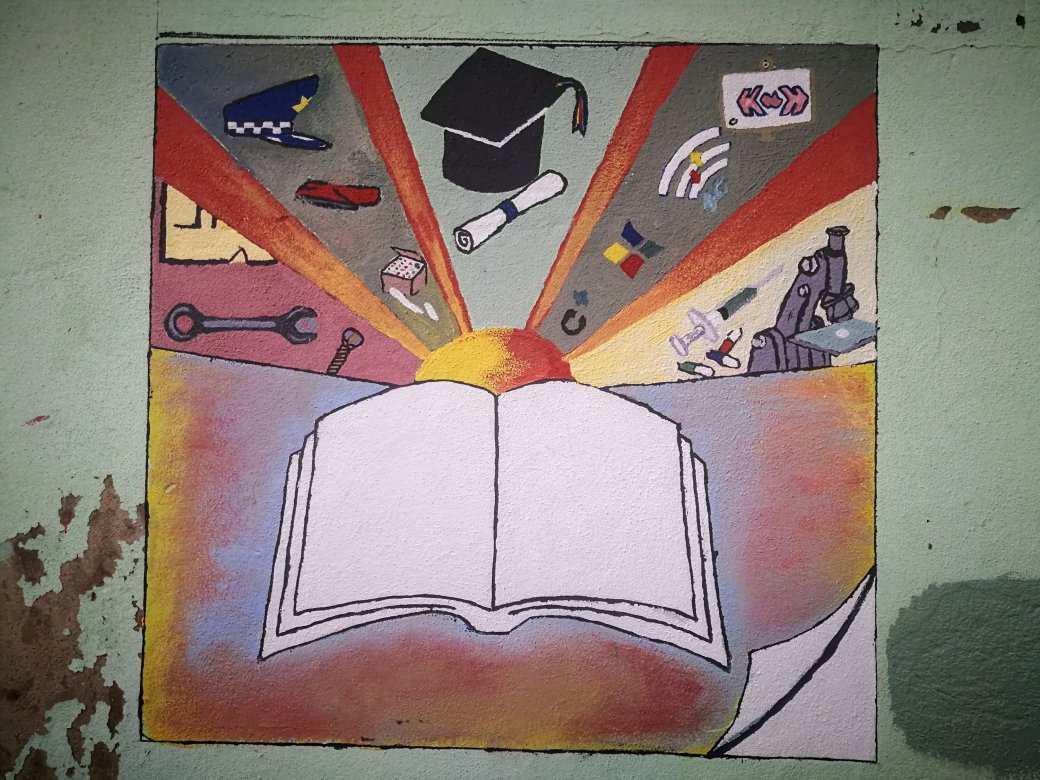
Some months back, a fellow PCV began planning a commemoration event called Walk The Nation. In 2008, a PCV in eSwatini organized a 200 kilometre walk to bring attention to the high HIV incidence in the country. The commemoration event was designed to look at how far the fight has come, and how much more needs to be done. Several PCVs participated in the commemoration of Walk The Nation by having events in their respective communities. Some volunteers showed documentaries while other marched and had discussions about where we go from here. Some volunteers were given paint to complete mural projects. Luckily, my community was given paint and associated supplies.

At my local high school, I spoke with students about HIV incidence and how far eSwatini has come. When I introduced the mural possibility, several students were excited and began working on concepts and drawings. Last week, our students (and a few recent alumni) completed the mural project. My hope is that as the student body sees this image, they will remember that education can lead them to any and all places.

Be kind to yourself.
Onward.

Let’s Talk About Sex

Sex is a very personal subject. Some people get uncomfortable at the mention or discussion of sexual acts. This is especially true of public spaces. The decision to write this post was an internal struggle. Two things pushed me to write this. First, I consider myself a sex positive person. Second, I would have liked a post like this two years when I was preparing for my service. I’ve seen a few threads on the topic on the Peace Corps subreddit, including one while I was writing this post. Most of the Google searches show results relating to sexual assault in Peace Corps.

Recently, I was reflecting on my service with another volunteer. The conversation shifted as we discussed some of the more challenging parts of service. It’s difficult to learn a new language and customs. But Peace Corps prepared us for that. Several PCV blogs chronicle the process of language learning and navigating new cultures. The other PCV and I agreed that one of the most difficult things about service in eSwatini is the lack of sex and intimacy.

Sex and intimacy happen in Peace Corps. Sex and intimacy happen in eSwatini. Things just may be a bit more rare. For me (and other PCVs here), there are a few different options. There’s the possibility of finding sex and intimacy by dating another PCV. There’s the possibility of finding sex and intimacy by dating someone local. There’s also the possibility of finding sex and intimacy by random sexual encounters with other PCVs and/or locals. Of course, there are advantages and disadvantages to each of these options.

Dating another PCV is great because you can commiserate with this person. Also, there are things that they will probably understand because they’re going through similar things. The not-so-great side about this relationship/situationship/arrangement is that the distance between you and your PCV bae may be long. You may not be able to see them as often, and in the times that you do see your PCV bae, there may be group gatherings. There’s also the fact that PCVs are a relatively small community. In eSwatini, there are about 80 of us. Sometimes when PCV relationships go awry, group dynamics shift and it’s not always pretty.

Dating a local can be great for several reasons. Many times, local bae is local meaning that you can see them more often. There are also the aspects of integration. Circumstances may dictate learning the language, culture, and customs at an accelerated rate. However, there is a personal teacher with a vested interest in your learning. On the flip side, there are challenges. Dating in eSwatini, especially in rural communities, looks different from the dating I’m used to. Casual dating isn’t really a thing. Dating is marriage-focused courtship.

While most people here take no interest in my love life, some Swazis, like my host mother, want me to date and find a wife here in eSwatini. Make wami (pronounced mah-gay wah-me), or my mother, says that I should stay here in southwest eSwatini, marry, build a home, and have many children (little Sibusisos, she calls them). Some Swazis don’t want me to date in the kingdom. A respected elder in my community cautioned, “Sibusiso, you can’t date any of the women here (in the community)”. When I asked if there was a reason, she stated that HIV and other STI rates were extremely high in our community. She also asked what I’d be doing with my girlfriend or wife when I left for America. She explained that I would ruin that wife or girlfriend if I didn’t take her with me. She further explained that such (in)actions would sour the relationship that our community/chiefdom has with Peace Corps. While I have taken the community elder’s advice about not dating in the local community, I have been on some individual dates with a few Swazis outside of my chiefdom. For reasons that I won’t get into here, things didn’t work out.

There are some PCVs who abstain during their service. Similar to folks stateside, PCVs abstain for religious, self development, or other personal reasons. There are also PCVs who choose to maintain long(er) distance relationships with significant others outside of eSwatini. Like various other relationship structures, some succeed while others fail. There is the very real stress that Peace Corps service places on a relationship, romantic or otherwise.

Earlier, I mentioned random sexual encounters. This happens from time to time among PCVs, and to a lesser extent with locals. Of course, there’s always masturbation. While every Peace Corps experience is different, I would recommend packing any toys and masturbatory aids that tickle your fancy. If you enjoy watching porn, I’d also recommend loading some of your favorite on your phone/computer/external hard drive/etc. Your future self will thank you.

My hope is that this post (and this blog, in general) serves to answer some of questions left unanswered (and often unasked) before I began service (for invitees, Peace Corps curious, and other interested parties). Of course, everyone’s experience varies and these are my musings from the kingdom of eSwatini.

Be kind to yourself.
Onward.

Monday in a Picture – The Staff Room

As you may know, I spend most days at a local high school. You can read about my adventures as a teacher here. However, I don’t teach all day, everyday. While some teachers here have dedicated spaces (think specialities like computers, wood shop, etc), many other teachers complete non-teaching duties in the room pictured above. It’s our staff room.

The staff room is also where I spend most my time when not teaching. I have a desk and a chair that I usually sit in. This is where I read, prepare lessons, and have lunch. At times, the staff room is host to all staff meetings and other trainings. The staff room is also where many student textbooks are stored when not in use. Students will visit the staff room to find teachers for extra assistance or to turn in assignments for grading. Sometimes, teachers will grade assignments (known as marking here) in the staff room. The stacks of notebooks seen above have student work from various student classes. Once the marking is done, one or two students will pick the stack to return to her/his classmates if students don’t retrieve their own notebooks.

Be kind to yourself.
Onward.

Sweet Dreams – Shoe Guy

Because I am posted in a country where I might contract malaria, I have been given an antimalarial medication called, “Mefloquine”. One of the side effects of this medication is lucid dreaming. The following is what I dreamt last night (as best I can remember).

There were some students visiting eSwatini. They were either law students or pre-law. I wasn’t sure what they what doing around the kingdom, but that didn’t matter. I started talking to one of the guys from the group. He had really puffy cheeks. It was like he was a puffer fish that was always puffed up. Anyways, he told me that they were collecting shoes. I thought that they were collecting shoes to give away to people locally. I had some shoes with lots of life left that I didn’t use anymore, so I donated those. Fast forward a week or two. Puffy cheek guy has started selling the shoes at really, really high prices. Almost no one can afford the shoes. The rest of the students in his group are chastising him. He responds that no one told him that he couldn’t do it. “There’s no law against it”, he says. His group of fellow students abandons him. He doesn’t care. He’s selling shoes.

A few weeks later, there’s some kind of sporting event going on. I decide to wear a nice black suit to the event. There’s only one problem. I only have brown shoes. I’m looking all over for black shoes. There are none. I’m not going to go to puffy cheek guy to buy some black shoes. I decide to go to the sporting event in black sandals, and it’s okay.

Be kind to yourself.
Onward.

Monday in a Picture – Superlatives

Every year, in Peace Corps eSwatini, the junior cohort plans a see-you-later party for the senior, outgoing cohort. In years past, it’s been referred to as Christmas in June. This year, the theme changed to Vikings. It’s typical for superlatives to be given to the senior, outgoing cohort.

After voting and deliberation, superlatives were announced and distributed. The above picture is me with my superlative. The members of G14 (my cohort) voted me….most likely to never return to the U.S. I don’t know how this happened, but never is a strong word. The above picture is of me with my superlative. Someone even drew my red shorts and beard, while I chill on a beach lounger.

Be kind to yourself.
Onward.

Monday in a Picture – Bereavement

Last Monday, I arrived at school like I always do. I noticed the head teacher talking to another teacher. It looked as though they were discussing important matters, so I acknowledged them and proceeded to lock up my bike. The head teacher approached me and told me that one of our students was killed in a car accident the previous Friday. The student was also a fellow teacher’s son.

In Swazi culture, it’s proper for the bereaved family to receive delegations from varied aspects of the deceased and their lives as people offer condolences. On Monday afternoon, we travelled, as a delegation of teachers, to the bereaved family’s homestead to offer condolences. This is done in one of the homes on the homestead that has been cleared out to receive guests. Songs were sung. Prayers were uttered. Tears were cried.

In rural eSwatini, the memorial services start either Friday or Saturday night with a night vigil. This past Saturday, several students and teachers travelled to the bereaved family’s homestead for the night vigil. There’s a very large tent set up for this occasion. Starting around 9 pm, the night vigil is like an extended church service/praise and worship session. There’s singing and dancing followed by sermon-like messages from people in attendance. It’s a joyous celebration. Around 3 am, there was a tea break. Hot tea and refreshments were served. After the break, there were more songs and prayers before speakers from various delegations offer condolences. The obituary was also read during this time. Singing and praying continued.

Around day break, services wrap up in the tent. Shortly after first light, there is a processional (behind the pallbearers) from the tent to family’s graveyard. This is usually on the homestead or relatively close. At the grave site, there are prayers before the body is lowered into the ground. The family then proceeds to fill the hole with the recently excavated dirt. After the hole is completely filled, there are prayers of thanks and benediction before people disperse. The above picture is of the processional to the grave site at first light.

Be kind to yourself.
Onward.

Monday in a Picture – The Med Hut

Guest post note: Fortunately, I haven’t had to take any trips to the medical unit for an overnight stay. But it is reality for many PCVs. Today, we have this guest post from G15 volunteer and sarcasm expert Christine Paquette sharing her experience.

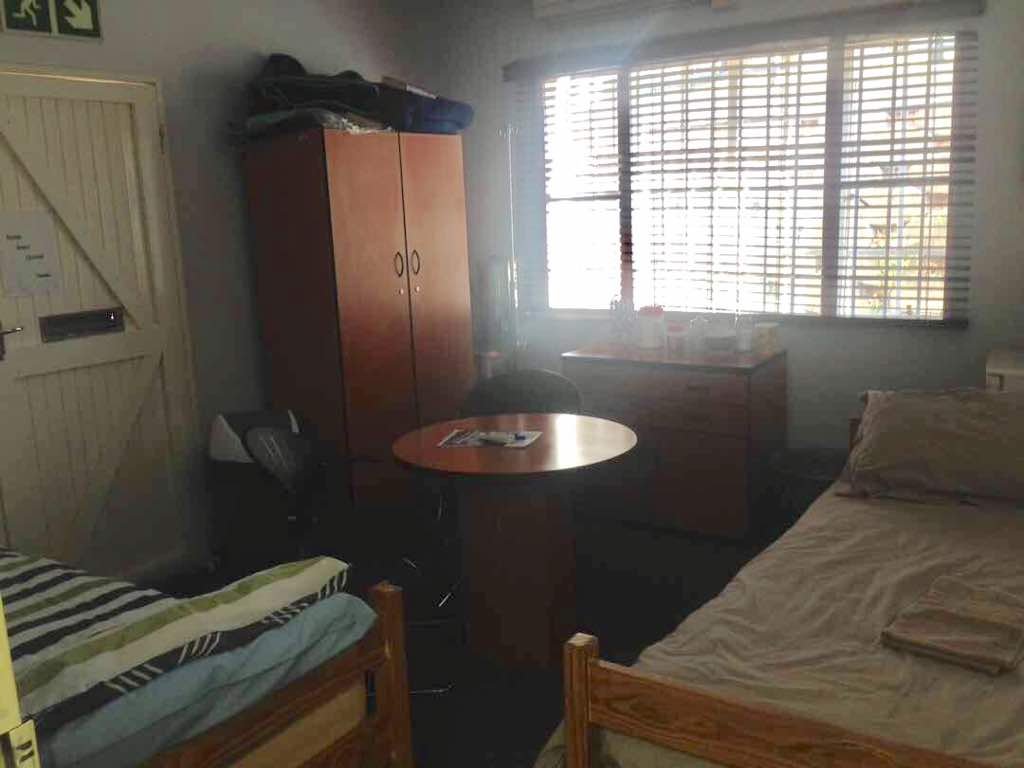
The med hut. The place where PCVs go when they aren’t their 100% jaded healthy self. At the beginning of November 2017, I had the pleasure of being there. I wish I could say that it was due to recovery from a stomach virus, a fractured something or another, or not bring able to make it back to site. Something ‘normal’.

I was there because I had an abscess (a painful skin infection where fluid gets between the layers of the skin making a deep red color) conveniently located in my ass area, specifically my butt crack. Getting to the office on public transport with a painful butt is the worse. Thankfully after having the fluid drained, taking antibiotics, and recovering out of site for about one week, my butt was healed. Since then, I have been counting my blessing and praying that my butt will never again be the reason I seek medical help. So far, so good.

The above picture features the inside of the med hut in Peace Corps Swaziland.

Be kind to yourself.
Onward.

Reflections on AfrikaBurn, Peace Corps service, and life

Recently, I’ve had time to reflect. We had our COS conference last week. Three weeks ago, I was galavanting in the Karoo desert during the experience that is AfrikaBurn. Last month marked eight years since my mother died after a long illness.

As I’ve been reflecting, some things became clearer to me. These are five recurring themes that I’ve learned from burns, service, and life.

Embrace impermanence

There’s a saying that there is no time like the present. Strike while the iron is hot. While it’s true that no moment lasts forever, it’s also true that life and all the things in it (including AfrikaBurn and Peace Corps) are mere moments. Admitting to ourselves that nothing is permanent (including us) allows us to fully engage in the now. Now is all we have. Why not love now? Forgive now. Embrace now. AfrikaBurn is seven days in a desert. Peace Corps is more than two years in an foreign community. While those moments won’t last, the memories do.

For the first time since I’ve started going to burns, I was ready to depart from the burn last month. AfrikaBurn was still magical. And it still left me high on life and the awesomeness of humanity. But while the high might be long lasting, it isn’t permanent. The need for a constant, permanent high is addiction.

Don’t try to recreate experiences

I remember discussing my first year at Burning Man with a friend of mine. He was excited as I recounted fond memories. I remember him expressing his desire to recreate my Burning Man experience for himself. When I was doing research on Peace Corps before I joined, I saw many volunteers doing amazing work. I arrived in Swaziland, and thought of replicating the work being done by the previous group. It makes sense. They are successful. I want to be successful. I need to do what they’re doing. I believe that the experience we have is heavily influenced by many factors including where we are in life at that time. The factors that made my first year at Burning Man so amazing might not be present in your life at this time. And that’s okay. I believe inspiration and aspirations are powerful, but they don’t have to dictate our path and experience. You are the creator of your own experience. Which leads me to…

It’s all made up

Everything that we see, hear, do and experience is all made up. JFK made up the Peace Corps. Larry Harvey made up Burning Man. Al Gore made up the internet. When wild imaginations are left in childhood, we try to create a better today instead innovating an exciting tomorrow. Life, like AfrikaBurn and Peace Corps, encourages experimentation and innovation. There’s even a camp at Burning Man called, “It’s All Made Up”. Shouts to the IAMU crew. Again, it’s up to us to create and co-create this thing called life.

Sit face to face with people

We live in a world with many things competing for our attention. Partially because of that, sensationalism abounds. We end up with strong opinions of people we’ve never met and know very little about. Real life people become the nameless, faceless “them” or “they”. This changes when we sit with someone, formerly known as strange(r), and experience their humaness through interactions. Suddenly, Burners aren’t a bunch of naked hippies doing drugs in a desert and Swazis (and by extension, Africans) aren’t a bunch of unintelligent, poor people living in mud huts. When we meet face to face, there is often some common ground. We get to deconstruct the single story bestowed on those who want to share their own stories. Even without common language, interests, and/or ideologies, we’re all humans sharing this planet.

Community Interaction

One of the principles of Burning Man culture is “participation”. To me, a large part of that participation is done through interacting with the space and the people in it. Through interaction, we co-create the life experience. In Peace Corps, I’ve found that magic happens when I am a participant in my community. Interacting with the community promotes growth and gets things done. Interaction also promotes relationships and seeing people as more than simple mediums if transaction.

Be kind to yourself.
Onward.

Monday in a Picture – COS (the conference)

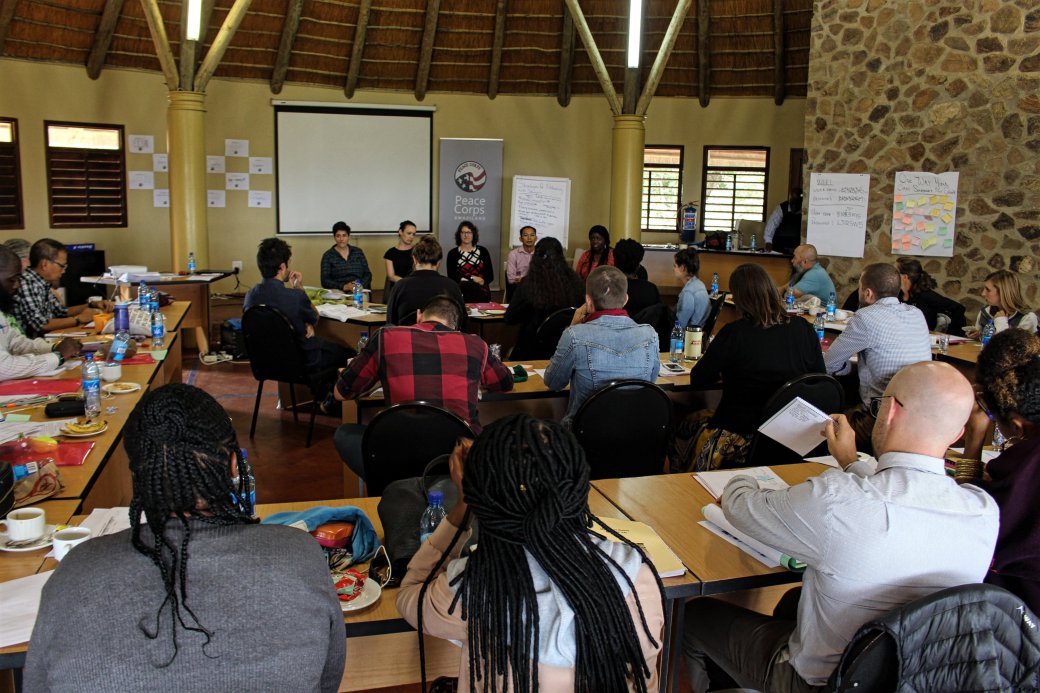
Last week, my cohort (group 14) came together for one last Peace Corps sponsored training. We assembled in the Lubumbo region of eSwatini for our Close of Service (COS) conference. This conference signals the beginning of the end. It’s held about three months before a group is set to leave.

We had our COS conference at a secluded nature reserve with beautiful views and spacious chalets. This was also the last time that we had to take a language proficiency test, which assessed how our language skills have grown throughout our service. We discussed the paperwork and conversations that need to be completed before we leave. We gave three stool samples to ensure that we aren’t leaving with parasitic friends in our respective bowels. We reflected on the work that we’ve done. We began to prepare for the adjustment and reverse culture shock that likely awaits us in America. We discussed how to best represent our service as we seek move on to careers, school or retirement. It was a full week.

While I’ll greatly miss eSwatini and emaswati (pronounced eh-mah-swah-tee), or Swazi people, I am excited for life after Peace Corps. The picture above was taken by PCV Nate during a session with a panel of RPCVs.

Be kind to yourself.
Onward.