Monday in a Picture – Tibi Tendlu

In 2016, a documentary premiered in Swaziland. It featured Swazis talking about Tibi Tendlu (pronounced tee-bee ten-jlu), or family dirt, including child abuse and gender based violence. A fellow Swaziland PCV recently kicked off an initiative to host screenings of the documentary for school aged girls and young women around Swaziland. My community was fortunate to participate in the screening series.

Last week, our high school hosted a screening of Tibi Tendlu. A facilitator involved in the screening’s post-production process joined us and led our GLOW club participants in discussions about gender based violence and family dirt. The girls were also provided with contact information for organizations that can help address gender based violence in Swaziland. The above photo is of the girls watching the documentary last week.

Be kind to yourself.
Onward.

Indlovukazi, or YAASSS QUEEN

I’ve written many times here about how confusing the siSwati language can be. This post isn’t entirely about that. (I should note that my students frequently remind me that English is extremely difficult, and I agree.) One example of siSwati’s confusion is any number of ways to refer to males and females. Umfana (pronounced oom-fa-nah) and lijaha (pronounced lee-jah-ha) both refer to an individual boy. Bhuti wami (pronounced boo-tee wah-me) and mnaketfu (pronounced oom-nah-gate-foo) both mean “my brother”. Make (pronounced mah-gay) means “mother”, but it’s also used at times to mean “woman”. Umfati (pronounced oom-fah-tee) means “wife”, but is also used to mean “woman” at times. Dzadzewetfu (pronounced zah-zay-wait-foo) and sisi wami (pronounced see-see wah-me) both mean “my sister”.

On my homestead, my host family consists of my host mother and sister. Others may come back at certain times of the year. One of the people who comes back often is my host brother, who lives and works in South Africa. He speaks many languages including Zulu, Sesotho, Afrikaans, and English. Sometimes, I understand the Zulu and very small pieces of Sesotho. When my brother speaks to our little sister, I try to follow the conversation. Luckily, most times it’s siSwati or Zulu. I noticed that whenever he addressed her, he always started “Indlovukazi…”. That’s not her given name (which no one uses) or her nickname (which everyone, including our make, uses). I kept hearing it.

Indlovukazi, ufunani kudla (what do you want to eat)?

Indlovukazi, ufundze njani (how was school)?

Indlovukazi…

Indlovukazi…

One day, I decided to ask him what Indlovukazi meant. He chuckled, and explained that Indlovukazi (pronounced en-jlo-voo-gah-zee) means “queen” in Zulu. (In siSwati, it’s Indlovukati). He went on to explain that he wants her to grow up knowing that she’s a queen and demand to be treated accordingly. He explained that it’s his responsibility as an older brother to demonstrate how the world should regard her. It’s true. Our little sister might have a few names and be called many things in her lifetime. I can only hope that she remembers she is Indlovukazi.

Be kind to yourself.
Onward.

P.S. – I would like to publicly thank my students who make sure I rise to the challenge of learning and speaking siSwati.

Monday in a Picture – Chicken Dust

One of the greatest ways to experience a place is through its food. Swaziland’s street food culture features a few staples. One of the meals that can be found all around Swaziland is chicken dust.

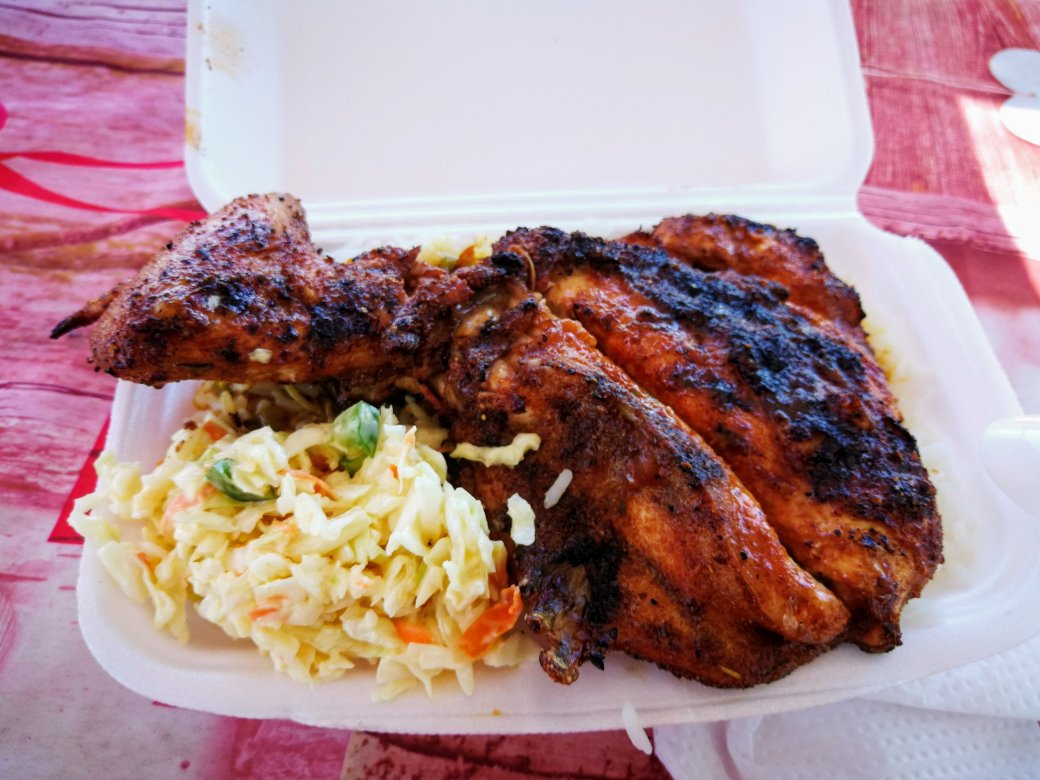
Chicken dust is a grilled chicken quarter typically served with a maize porridge known as lipaleshi (pronounced lee-pah-lee-she), or pap, and salad. Some chicken dust stands give the option of fries or rice. You may be wondering why it’s called chicken dust. The short answer is: I don’t know. I suppose that it may be because of the placement of chicken dust stands on the side of the road where dust can be kicked up by passing cars. But again, I don’t know. Chicken dust is a good, quick lunch or dinner that will cost 20-25 emalangeni.

While I haven’t experience all chicken dust places in Swaziland, I’m confident that the best chicken dust can be found in Mankayane across from the bus rank. They give the option of pap or rice to accompany their flavorful, juicy chicken. Be sure to treat yourself to this Swazi delicacy if you’re ever in the neighborhood. The above picture features the delicious chicken dust from Mankayane.

Be kind to yourself.
Onward.

Monday in a Picture – A Bug’s Life

Swaziland has opened my eyes to many new things. I have a newfound love of ice water and mangoes. Learning siSwati has introduced a culture of depth and tradition. I have also taken a special interest in the small critters I see in the rural community.

Apparently, this is a thing for PCVs in many countries. A PCV in Mozambique organizes and curates an Instagram account (@woahinsecto) featuring insects from all over the world. Growing up in an urban environment, I found insects to be a nuisance. When I did journey to more rural places on family vacations, the insects were huge and had stingers that left itchy bumps. The only insect that had redeeming qualities was the firefly because it lit up the summer sky.

I’ve seen creatures here that are truly stunning. Some of the tiny critters are extremely hairy. Other critters are incredibly colourful. A couple of weeks ago, I was at school heading to class when I saw the critter pictured above. I thought it might jump when I got close, but it didn’t. It did start walking away. Luckily, I was able to get close enough to snap this picture.

Be kind to yourself.
Onward.

P.S. – According to @woahinsecto, the creature above is the Pygromorphidae and their colors are a warning to predators that they are chemically protected!

Rolling siSwati and toddler fluency

A few weeks ago, I was leaving school to go home. As I pass the gate and say bye to the students, I hear “c’ombole” as one of the students points to my bike. The confused look on my face lets them know that I don’t understand. “Cela boleke“, they clarify. I’m understanding a little better now.

One of the students explains c’ombole is the shortened version of cela boleke (pronounced click c-eh-la bo-lay-gay) meaning “please borrow me…/may I borrow…”. In this instance, the student was asking to borrow my bike. The student who explained the shortened siSwati went on to entertain my lamenting about how siSwati changes whenever I feel like I have a handle on it. She explained the concept of rolling siSwati by comparing it to English contractions and various stylistic preferences (that are present when speaking any language).

In English, “How are you doing?” becomes “How you?”; “cannot” becomes “can’t”; and “Where are you?” becomes “Where you at?” In siSwati, “uyakuphi” (pronounced oo-ya-goo-pee) becomes “uyaku” (pronounced oo-ya-goo) or “uya” (pronounced oo-yah). No meaning is lost, and the listener understands you want to know where s/he is going. This is not to be confused with “ukuphi…” (pronounced oo-goo-pee) meaning “Where is (a person)?” Sometimes, this gets rolled into “uku…” (pronounced oo-goo) or “uphi…” (pronounced oo-pee). Take for example the phrase, “ufuna ini ku wati” (pronounced oo-foo-nah ee-knee goo wah-tee). In everyday siSwati, this phrase becomes “ufunani kwati” (pronounced oo-foo-nah-knee gwah-tee). Both phrases are asking what you want to know.

With these realizations, I decided that I would focus on speaking and listening rather than reading and writing. One of the things that has helped me with this focus is a mobile voice recording app. When I hear a word or phrase I don’t understand, I record myself enunciating the word or phrase several times in siSwati with its English meaning. From time to time, I go back and listen to the recordings to refresh my memory. In that vain, I’d suspect that I’m around the fluency of an average toddler. Maybe a slightly below average toddler. Like toddlers, my subjects don’t always agree with my verbs. Sometimes, I mispronounce things. It’s possible that I might need something explained repeatedly. But eventually, we all understand. My conversations with toddlers and preschoolers are awesome, as everyone understands what’s being said. Sometimes, I can manage a conversation with my gogo, or grandmother.

Be kind to yourself.
Onward.

Monday in a Picture – Sihambile eWakanda

Warning: This post does have some spoilers regarding Black Panther.

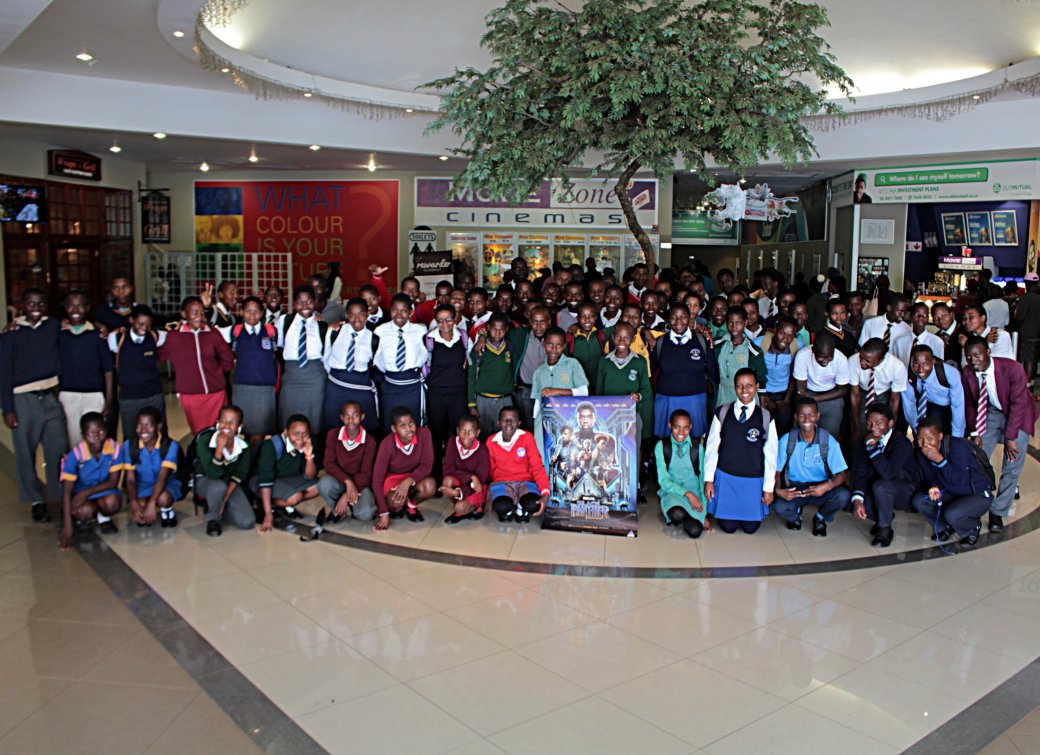
I’m writing this on Wednesday 21 February. Today, students from 14 different communities across Swaziland came together to journey to Wakanda. Some students and chaperones traveled for hours to Swaziland’s only movie theatre. As I journey back to school with my students, I’m tired and happy. My heart is full.

For many students, this was their first trip to the cinema. They were excited. I was excited. Everyone was excited. The students were able to meet and fellowship with other students from around the kingdom. And as an added bonus, they got treated to the cinematic experience that is Black Panther. After the movie, several students gave a Wakandan salute and two thumbs up. I was able to speak with some of my students after the film about their thoughts and reactions. One student said that he enjoyed the film overall, but that he was really appreciative of how the ancestors were intertwined into the story. To see T‘Challa consulting his late father in the ancestral plane was powerful. Another student was enthralled with the relationship between Africans and Black Americans as he sought to understand why Killmonger wanted to destroy Wakanda.

I must say that I have a newfound appreciation for the teachers and other responsible adults who chaperone field trips regularly. If you haven’t experienced this film yet, I’d highly recommend it. It’s a cinematic delight.

The above picture was taken just before the students went into the theatre to see Black Panther. On a related note, I never knew how difficult it was to get 70+ school children to stay still long enough to take a picture.

Be kind to yourself.
Onward.

P.S. – Sihambile eWakanda means “We went to Wakanda”.

P.P.S – Here’s a picture of me, my counterpart, and our top students (per last year’s results).

Monday in a Picture – The News

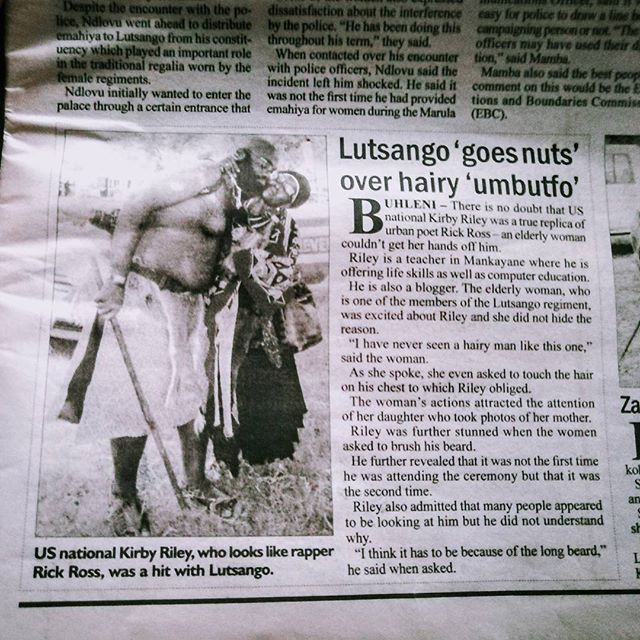
Swaziland is home to at least 3 different regular newspapers. The Times of Swaziland and the Swazi Observer are daily publications. I rarely see the Swazi News, but it’s here. All of these regular newspapers are written in English. I’ve been told that there was previously a siSwati language newspaper as well. All of the newspapers cost five emalangeni each. While the Swazi Observer markets itself as “Revived, Reliable and Read”, Swazi News says that it’s “A Complete Read”. The Times of Swaziland states that it’s been “The National Newspaper of Swaziland since 1897”. The Times of Swaziland is the oldest newspaper in Swaziland. The above picture shows print editions of the three periodicals from previous months. 

Be kind to yourself. 
Onward.