​Monday in a Picture – Bomake Market 

All around Swaziland this week, schools are closing for the year. The academic year here is divided into three terms. The school day is typically divided into different lessons with two breaks. The first break is mid-morning, and lasts approximately 30 minutes. The second break is a lunch break, and lasts approximately 50 minutes. 

During these breaks, 2-4 bomake (pronounced bow-mah-gay), or women set up a snack market on the school grounds. The schools don’t have vending machines. In fact, I haven’t seen any vending machines in the kingdom, that I can remember. The bomake sell all kinds of goodies. These goodies include naks (a maize based snack similar to Cheetos that comes in different flavors), lollipops, popcorn, rolls (called buns here), and fatcakes. On really hot days, there are even ice blocks (a flavored, sweetened frozen slushy solid). 

I’ve noticed that the prices for snacks at the bomake market are pretty standardized. For instance, the going rate for a fatcake or an ice block is one lilangeni, pronounced lee-lan-gay-knee (the currency of Swaziland). The prices remain the same at most, if not all, of the school bomake markets in Swaziland. The homemade snacks (i.e., fatcakes) taste very similar all around the country as well. 

Be kind to yourself. 
Onward. 

​My favorite things – the packing list

While preparing for Peace Corps service can be hectic among other more colorful adjectives, it’s an exercise in restraint. It was tempting to pack up my entire apartment in Washington, DC and bring all of that stuff with me to Swaziland. I’m very thankful that I didn’t. After searching other volunteer blogs and Reddit to decide what to bring, I narrowed my list down. This is my contribution to that pool of knowledge. There are some things that I’m very happy I packed (outside of the typical – clothes, phone, computer, etc), as they have proved most useful. 

  • Headlamp – I brought two. I have electricity on my homestead. I had electricity at my training site during my first three months in country. However, a headlamp is useful, especially on those 2AM runs to the latrine or when the power goes out while cooking dinner. 
  • Hydroflask – This could be considered a water bottle, but it’s so much more. To be able to have an ice cold (or steaming hot) beverage after working all day is pure magic. 
  • Duct tape – It’s multipurposed, and magical. 
  • Rechargeable batteries – These save me money and trips into town. I use them for my headlamps, camera, and other lights. 
  • Power bank – There are instances when the electricity goes out, due to heavy rains. There are also times when I’m not at home, and my phone, watch, or some other gadget is about to run out of battery. I can at least ensure that I have enough battery power to last until the next time I can plug in.  
  • Bluetooth headphones/speaker – I really enjoy music and podcasts. While walking. While running. While on a long bus ride. The speaker is especially great for music while cooking/washing doing laundry. The headphones are great for being able to hear the movie I’m watching over the pounding rain on my tin roof. 
  • Comfort items – This is going to mean something different to everyone. For me, it included pictures from my apartment in DC and various gadgets. I’ll throw snacks into this category, as well. Go overboard with your favorite snacks. Add in your second and third favorite snacks as well. If you have to choose between a few more clothing items and snacks, go for the snacks. 
  • External hard drive – We were told that there would be plenty of time to share media. This was correct. We were also warned that we would have a substantial amount of down time. This was also correct. Load up your favorite movies, music, tv shows, podcasts, porn, documentaries, etc. Having an external hard drive is also helpful when it comes to storing backups of your system. Your future self will thank you! 
  • Big, blue IKEA bags – I didn’t pack this. A friend was kind enough to send some to me. These things are an invaluable resource when navigating public transit after grocery shopping for two to three weeks. And it’s good for the Earth.
  • Pillow – This could go under comfort items, but it deserves its own bullet. While there can be too many pillows, that threshold is pretty high. I opted for a firm king size pillow. It’s delightful to fall asleep on it every night. 

Feel free to add your own favorite things in comments. Also, if any future volunteers have questions, feel free to ask them here. 

Be kind to yourself. 
Onward. 

​Monday in a Picture – Thanksgiving

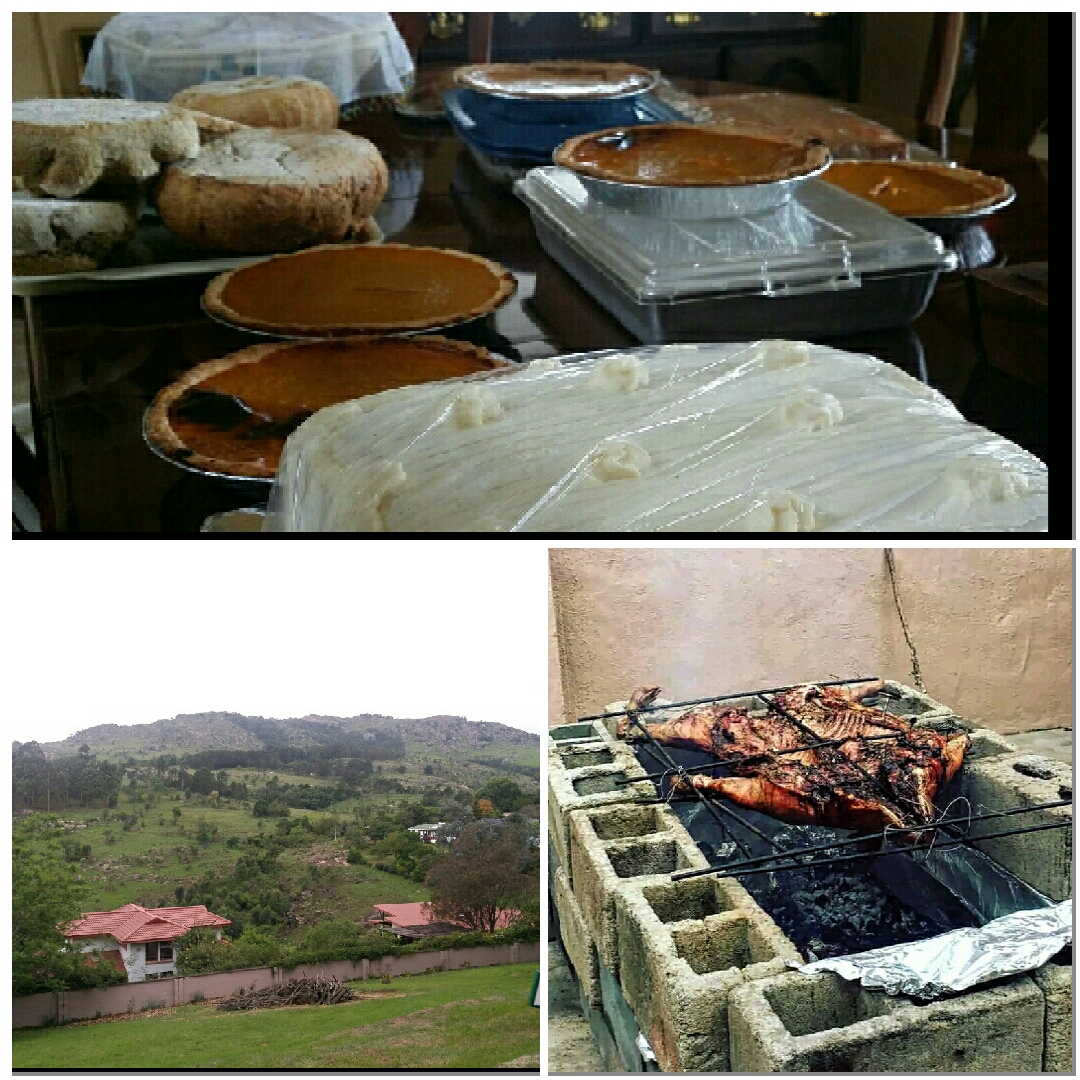
This past Thursday was Thanksgiving, an American holiday of food, family, and football. For those who may not know, Thanksgiving isn’t celebrated here in Swaziland. It’s simply another Thursday in November. For the occasion, our country director invited all of the volunteers in Swaziland to her beautiful home for a momentous feast. I wasn’t able to get pictures of all of the food, but the above collage is a bit of what our eyes and tastebuds enjoyed on Thursday afternoon. 

While the chefs were putting the final touches on the meal, I was able to relax by the pool and chat with other volunteers. There was also badminton and other backyard games to be played. This was definitely the first Thanksgiving that I was able to chill in a pool and soak up some sun. I could used to Thanksgiving as a summer holiday. 

Several volunteers and staff helped prepare various delicious dishes. It was indeed, a feast. There were four turkeys (two baked, two fried), a roasted pig, and a sizeable salmon. We enjoyed several types of stuffing, macaroni and cheese, fried cabbage, mashed potatoes, candied yams, green bean casserole and more. There were appetizers to whet our palettes, and desserts to satisfy the most distinguishing sweet tooth. 

I have a newfound respect and admiration for those who host large holiday gatherings at their home. There were more than 70 of us. There were dietary restrictions and food allergies to be observed, but there was still something for everyone. 

I wanted to take this opportunity to publicly give thanks and gratitude to our country director for hosting us in her home (and for taking suggestions on the menu); all of the volunteers here in Swaziland, for being a supportive and amazing group of folks; all of the chefs who made the meal magical; and my brother and uncle, for WhatsApping me their Thanksgiving greetings. 

Be kind to yourself. 
Onward. 

​Monday in a Picture – The Shirt Off His Back 

This past Saturday, I went to a basketball game in one of the major hubs of Swaziland, Manzini. Some ladies I know were playing in a women’s game, and I wanted to support. Though my team lost, the game was competitive and exciting. It was also good to be at a familiar sporting event. (While I vaguely understand soccer, I don’t follow it nearly as much.)

After the game, I was chatting with friends outside when I saw a guy wearing a tee shirt. Spoiler alert: it’s the shirt seen above. I approached him, and told him that I liked his shirt. He thanked me, and told me that it was an extra large. I thought nothing of him telling me the size until he started taking off the shirt. He handed it to me. I told him that he didn’t have to give me his shirt. He insisted. I thanked him repeatedly, and we embraced. He smiled, and told me that he wanted me to enjoy my time in Swaziland. 

I couldn’t stop smiling. I felt so much love. To feel that connection was so amazing. 

Be kind to yourself. 
Onward. 

​Monday in a Picture – Plowing and Planting 

Everything in life has seasons. Election season in the US is over. American football season is in its prime, while basketball season is just starting. Right now, Swaziland is heading into summer, which is the rainy season. Warm temperatures and rain mean that it’s time to plow and plant. 
The staple crop in Swaziland is umbila (pronounced om-bee-la), or maize. The staple food is liphaleshi (pronounced lee-pa-lee-she), or porridge, which is made from ground maize meal. In my community, all homesteads have some land set aside for crop farming. Many of these families will grow substantial portions of their needed maize during the summer months. Some families may even have extra to sell. But before any growing can be done, the fields have to be readied. This includes plowing the field(s), which is sometimes done by hand with a hoe, shovel, or pick. It can also be done with a tractor pulled plow (as seen in the picture above). 

I spoke with these guys for a bit. They told me that this was a prime season to make money for their respective families. You can hire these guys to plow your field (assuming you live close by). I learned that they work all day, literally. They start working around 4:00 a.m., and work until 7 or 8:00 p.m. That’s a laborious workday that starts before the sun rises, and ends after it sets. They told me not to worry because they had a light on the tractor for working in the dark.  The conversation was brief because there were fields to be plowed and money to be made. Before they left, the driver asked if I could take his picture. Wish granted. 

Be kind to yourself. 
Onward. 

​Monday in a Picture – Creepy crawlies 

When I’ve perused various forums and blogs, I noticed that one big concern for some future PCVs and those considering Peace Corps is bugs. There’s the “but what do I do if there’s a (insert scary bug here)” question. I hadn’t given much thought to my own possible reaction. That is until this past Friday. 

I was sitting on my porch enjoying a nice, early summer Friday evening when I noticed something. A spider. To be fair, I’ve seen spiders before. I saw them as a young boy and occasionally in my adult life. I’ve encountered spiders and other things (lizards, flying insects, etc.) inside my home here in Swaziland. This spider was different. It is the biggest and hairiest spider I’ve ever seen in real life. Suddenly, my Friday evening arrives at a decision point. Do I:

A. Kill the spider? 

B. Name the spider and keep it as a pet? 

C. Redirect or relocate the spider? 

D. Go inside? 

E. Do nothing? 

If you guessed (D.), you would be correct. I have no idea what kind of spider it is, whether it bites, or its overall danger. The spider seemed to be having a fine Friday evening. I wouldn’t want to ruin the spider’s evening because I didn’t want to share the great outdoors. Live and let live. 

Be kind to yourself. 
Onward. 

P.S. – if you didn’t do it early (and you’re eligible), be sure to vote tomorrow! #DCStatehood

Stage Fright

​One of the things that has been required of us, as Peace Corps volunteers in Swaziland, is ongoing language learning. This makes perfect sense to me. As we learn more about Swazi culture and start to understand it better, language is key. 

I have found an amazing language tutor who is patient enough to answer my “but why is like this instead of like this” questions, and stern enough to correct me when I’m wrong (repeatedly). 

If I were to do an honest self-assessment, I’d say that my language skills have definitely improved since ending our pre-service training (albeit in miniscule increments). My language skills have improved dramatically since coming to Swaziland almost five months ago. At this point in my language learning, I’m able to semi-confidently hold a conversation with a preschooler. I’m proud of this. I want to be able to confidently have intense conversations with peers and boMkhulu (pronounced bo-mmm-koo-loo) or elder men/grandfathers in the community. I want to be able to understand jokes and be sarcastic in siSwati. I want to understand what folks are asking for when they come to my homestead. I would like to go a day without speaking English, but not be silent. My host make (pronounced mah-gay), or mom, recently told me that next year, no English will be spoken. SiSwati only. Of note: she told me when I first arrived that I must speak siSwati. “Sibusiso, you’re not in America anymore. We speak siSwati here.” 

I think I’ve identified what one of the bigger barriers is for me currently. Stage fright. My receptive language is definitely getting better. I can understand some of what’s said in small talk conversations on khombis (local mass transport vans). My expressive language is where my stage fright is the star of the show. I start to wonder if I actually heard what I thought I heard. Do I have the language to respond to that? Do I have enough vocabulary to keep the conversation going? Do I just want to use the fail safe phrase? Angiva (pronounced ah-knee-va), or I don’t understand. I guess the only way to overcome it is to keep practicing and understanding that failing doesn’t mean failure. After all, winning the World Series is impossible if you never step up to the plate and take a swing. 

Be kind to yourself. 
Onward. 

P.S. – Did you know that @whatisKirbydoing is an Instagram handle? Be sure to follow the fun. 

Monday in a Picture – Fat cakes

So, I’ve mentioned these before. A fat cake is a fried ball of sugary dough. While it definitely isn’t the standard of nutritious meals, it is delicious. 

Within a month of arriving in Swaziland, I was introduced to fat cakes. Bomake (pronounced boe-mah-gay), or women sell them at the markets, schools, and road side stands. After having several magnificent fat cake experiences and seeing the recipe in our Peace Corps cookbook, I decided that I would try to make them myself. 

Here’s the recipe, as written in the cook book:

  • 1 1/4 cup flour
  • 2 tablespoons sugar
  • 1 teaspoon baking powder
  • 1 teaspoon ground cardamom
  • 1 egg
  • 1/4 cup milk
  • Oil for frying
  1. Mix dry ingredients. 
  2. Stir in egg and milk. 
  3. For lumpy mafeti (pronounced mah-fay-tee), or fat cakes, drop by spoonfuls into hot oil. 
  4. For better looks, roll out to about 3/4 inch thickness on a well floured surface and cut into triangles before frying. 
  5. For a chewier texture, knead dough with extra flour for about five minutes and let rest for half an hour before rolling out.

I should probably say that I took a few culinary, creative liberties. Of note, I did not use measuring cups. While mixing, I just added more wet or dry ingredient until the mixture was a consistency between that of pancake batter and bread dough. I also did not have cardamom. It wasn’t in my budget, and it’s not that serious. Instead, I added a generous amount of imitation vanilla extract. When the dough was ready, I heated up my makeshift deep fryer (a pot filled with cooking oil). I scooped out a oversized spoonful, and dipped the spoon in the oil. The deep fried goodness was almost ready for enjoyment. After I removed the cooked fat cakes from the hot oil, I let them rest and cool for a minute or two. The last step is perhaps the most important. I poured some powdered sugar (known as icing sugar here in Swaziland) in a plastic bag, and added the freshly fried (still warm) fat cakes. A vigorous shake ensures that the fat cakes are nicely covered. They are now ready to enjoy! Try out the recipe, and let me know how it goes. 

Be kind to yourself. 
Onward. 

​Monday in a Picture – The Head

When a cow, or inkhomo (pronounced inn-co-moe), is slaughtered, there is a lot of meat. The meaty goodness is a carnivore’s dream. After everyone has had some meat, rice or porridge, and cabbage, bobabe (pronounced bo-bah-bay), or men, gather around dishes filled with more meat.

This past weekend when this happened, one of the men invited me to join them as they prepared to eat from the meat filled dishes. On these dishes was something of a Swazi delicacy. It was the cow’s head. The picture above is only half of the cow head meat. 

I had heard stories about the sacredness of the  cow head, how delicious it was, and how women are discouraged from consuming it. According to some beliefs, fertility problems might come to women who eat the cow’s head. I’ve also been told that eating cow head meat increases intelligence and virility in men. 

I sat down with the men and we started to eat. There were no plates, no cutlery, and no napkins. There was a beautiful sense of community as we ate or half of the cow’s head. It I couldn’t tell you if I ate the cheek, tongue, neck, or other part of the cow head. I can guess that most of the meat was grilled, while some was boiled. What I can tell you (with certainty) is that whatever I ate, it was delicious. It was juicy and full of flavor. The cow head is probably the most flavorful and tender meat I’ve tasted since arriving in Swaziland. It did have a slight garlicky aftertaste, but it was nothing compared to the deliciousness. 

Be kind to yourself. 
Onward. 

On the outside, looking in

​The year was 2011. I had purchased a roundtrip ticket from Washington, DC to Cape Town, South Africa. I would be vacationing in southern Africa for almost a month. I wanted to do all there was to do, and see all there was to see. While crossing a border (either from Mozambique to Swaziland, or Swaziland to South Africa), I started talking with one of the other passengers on the bus as we waited for everyone to clear customs and immigration. He asked me where I was from and if this was my first time in Africa. I told him that it was my first time, and that I lived in DC. He, a Mozambican  working in South Africa, went on to ask me how Africa was treating me. I let him know that I was enjoying my time and that everyone had been very welcoming and kind. His response has stayed with me, and probably will forever. He expressed happiness that Africa had been so welcoming. He told me that I was always welcome here, and that any family or friends would welcomed just as warmly across the continent. Wow! 

Fast forward to now. October 2016. I live in southern Africa. In Swaziland, on the border with South Africa. I have been asked family, friends, and locals if I’m scared, or worried, being so far away from home. I’m not. When I actually reflect on the state of affairs around the globe (especially in the US), I’m actually worried to return to the US. I’m a burly, bearded 30-something Black man, and I have feared and would fear for my safety in various parts of the US much more than here in Swaziland. 

Last year, as riots filled the streets of Baltimore (a 40 minute drive north of DC), I watched news coverage from my living room. People were fed up with another Black man dying at the hands of law enforcement officers. That evening, I received a text message from my brother saying, “Stay safe. It’s only a matter of time before the revolution makes down there (to DC).” Since I left the US in June, there have been even more Black people to die at the hands of law enforcement. There aren’t the same massive protests that seemed commonplace even a year ago when Black people were killed by law enforcement. I doubt that the protests can keep up with the shootings. As I write this, I think about that text message from my brother. I think about sending him a similar message. It’s a strange dichotomy. Some family and friends fear for my safety here in Swaziland, while I have similar fears for their respective safety across the US. 

In contrast to the many law enforcement shootings at home, I feel really safe, warm, and welcomed here in Swaziland. This is the country that has been called one of the friendliest in Africa. I’ve only seen one police officer with a firearm, and that was weird to see. The biggest fear of crime against me that I have here is being robbed or having something stolen, which is miniscule compared to my worries about speaking siSwati more fluently and being understood. 

Be kind to yourself.
Onward.