​Monday in a Picture – Community Shop

Grocery shopping is an all day task for me from my rural community. It involves taking public transportation to a town that’s approximately 25 kilometers away. Because it’s such a time intensive activity, I try to limit my trips to once or twice a month. I have also started using a grocery list to make sure I get everything that I need. 

Inevitably, there is something that I forgot while on my grocery shopping excursion. For anything that I did forget or didn’t put on my list, there’s the sitolo (pronounced see-toe-low), or shop. At a community shop, you can find essential items like bread, rice, cooking oil, and beans among other things. My community has at least four shops. The shops vary in size. They also vary in their offerings. At least one of the shops in my community sells various cuts of meat and margarine. 

The prices at the community shops are a tad more expensive than prices at larger grocers. Even in Swaziland, stores that are convenient have a price for that convenience. And it’s very convenient to spend a rand or two more for a few items instead of spending an entire day (plus transportation money) to get those same items. 

Be kind to yourself.
Onward.

Follow What is Kirby Doing? on WordPress.com

Monday in a Picture – New Year, New Haiku (times two)

Happy New Year! Bonne
année
from Madagascar. 
Love meaningfully. 

My mother almost
named me “George Quincy”. She knew
she’d just birthed GQ. 

Be kind to yourself.
Onward.

Follow What is Kirby Doing? on WordPress.com

P.S. – Bonne année means “Happy New Year” in French. 

​Monday in a Picture – New Bike Day 

Merry Christmas from sunny Swaziland! In addition to Christmas, I recently celebrated another holiday: New Bike Day! Santa made an early stop to drop off a new bike in the Manzini region. I’m beyond elated. Peace Corps Swaziland approved me for reimbursement to get a bike just over a week ago. 

I knew that I wanted something that I would enjoy riding in my rural community. I wanted something that I could use for transport, recreation, and commuting. After speaking with a fellow PCV and a local Swazi about their respective bike buying experiences in Swaziland, I decided that I would check out Adventure Cycles in Manzini. 

I also decided that I would be purchasing a hardtail mountain bike. The shop had many options for mountain bikes. There were a few full suspension bikes that stole my attention for a while, but I regained focus. I wanted to have something that I would be comfortable fixing myself.  There were also some road bikes that caught my attention. However, I live in a community with gravel/dirt roads, so a road bike was out of the question. Again, I regained focus. As I perused the selection of hardtails, I settled on a beauty. 

This Scott Aspect 680 came home with me last week, and it is amazing! On its maiden voyage, it performed very well. It took everything I could throw at it. It handled like a dream while riding the gravel roads. It’s much more speedy than I was expecting. The suspension was phenomenal, and the ride wasn’t nearly as jolting as I thought it would be on the bumpy road. Of course, my legs reminded me that I should never be away from cycling this long. I’m confident to say that this bike was the right decision. 

For those of you who may be wondering, I have not named this bike (yet). Feel free to leave any name suggestions in the comments. 

Be kind to yourself. 
Onward. 

Follow What is Kirby Doing? on WordPress.com

​Monday in a Picture – Incwala 

Today in Swaziland is a public holiday, as Swazis observe incwala (pronounced in-click wa-la), which is also known as the festival of the first fruits. 

The festival is a celebration of the king and his kingship. While the festival takes place over the course of several days, there is one main day. During this day, men and boys from all over the country do traditional dances and sing traditional songs with the king and his regiment in the royal kraal (pronounced exactly like “crawl”) at a royal residence in Lobamba. 

This year’s main day was Saturday. I was fortunate to attend the ceremony with some other volunteers. Immediately outside of the royal kraal, the king’s guards were lined up in uniform. Behind them was a small marching band in a different uniform. We noticed everyone moving towards the barricade, so we followed suit. The king was coming! Before the dancing and singing starts in the royal kraal, the band plays the Swazi national anthem and the king inspects his guards and their uniforms.

After the inspection, people are now free to pass through security and join the ceremony in the royal kraal. The rules are very strict for those wishing to enter. We were not allowed to take pictures of the royal kraal activities, wear shoes inside, or have any electronics with us. 

Once inside, all participants circle the king and members of the royal family while dancing and singing. While men and women are allowed to participate in the festivities (on the main day), people are separated by gender. For this festival, men drastically outnumber women. 

Before all of the ceremonies started, we were conversing with a group of men dressing for the ceremony. One of the men decided that I should adorn proper headdress. The picture above is him putting it on me.

Although we didn’t know the dance steps or the songs, the Swazi men and boys were extremely helpful and inclusive.  I am tremendously grateful for the hospitality that Swaziland, both individually and collectively, has shown.  

Happy Incwala Day! 
Be kind to yourself. 
Onward. 

Follow What is Kirby Doing? on WordPress.com

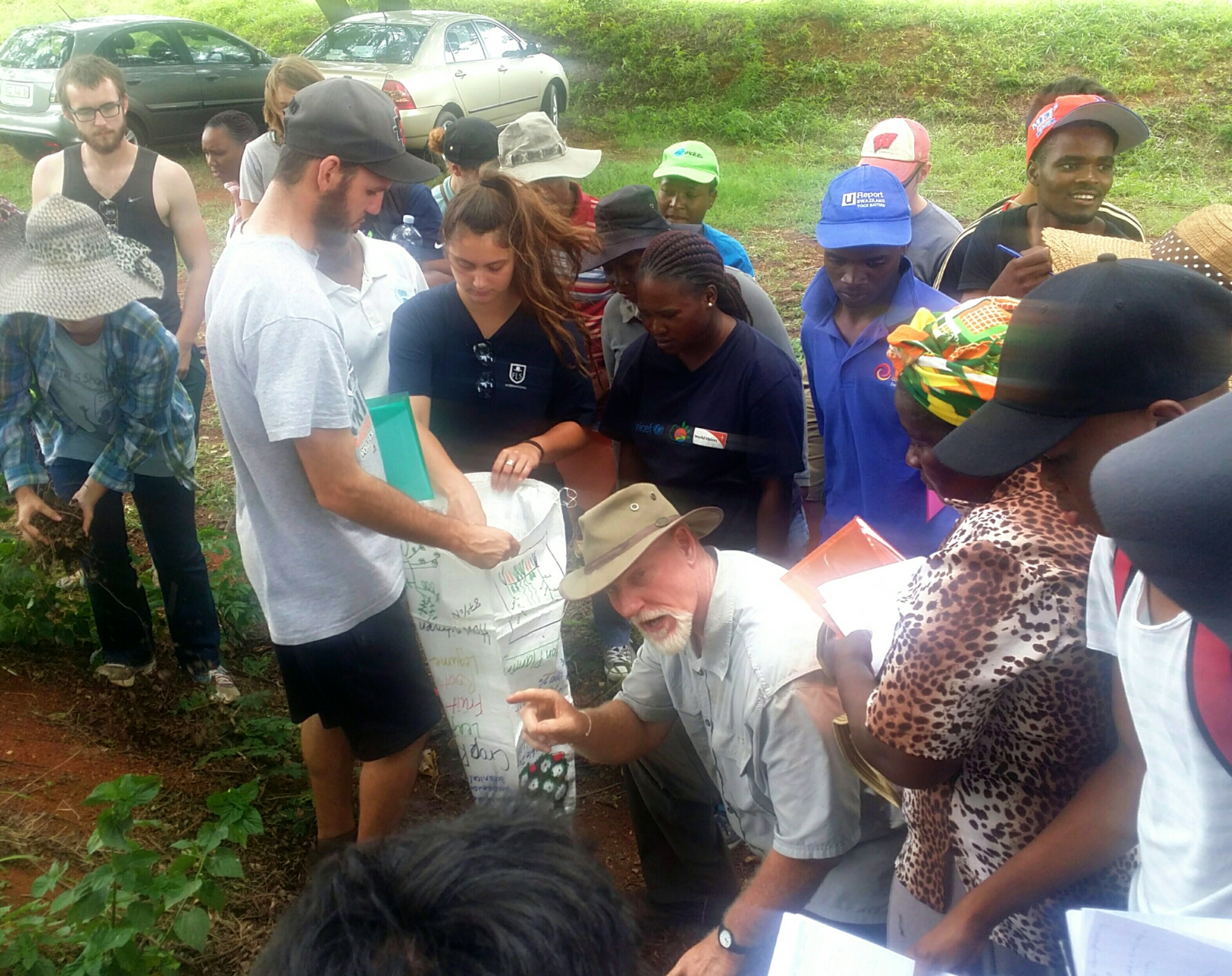
​Monday in a Picture – Grow Your Own Food: The Training

Last week, Peace Corps Swaziland hosted Peter Jensen, a permagardening specialist based out of Peace Corps Ethiopia, to facilitate two workshops on his specialty. Volunteers were invited to participate in the workshop with a counterpart (community-based colleague), with the expectation that the volunteer and counterpart would take what they learned to train others in the local community. 

For those wondering what exactly permagardening is, allow me to share my understanding. Permagardening is a permanent garden that focuses on strict natural water management, double digging, and using locally accessible materials to keep the garden and soil healthy and productive.

I attended one of the workshops with a counselor from my community. She’s an agriculture friendly person who grows various things on her homestead. In contrast, the only plant I’ve managed to grow with any success is ivy, which is extremely difficult to kill. Peter presented permagardens in a way that was accessible and interesting to novices, like myself, and experienced folk, like my counterpart. He made me believe that even I can build a fruitful garden using the permagardening techniques and principles. The workshop inspired a conversation between me and my counterpart about how to take these techniques back to the community. Currently, we are planning on building three demonstration gardens around the community. 

When I returned to my home, I talked with my host mom about the possibility of me building a garden. She excitedly pointed me to a fenced area on the homestead and told me that I could use that space. Now, I have the space, some tools, and the training to practice before co-facilitating a community training. The only thing left to do is the work of actually building the garden. Wish me luck! 

Be kind to yourself. 
Onward. 

​Monday in a Picture – Bomake Market 

All around Swaziland this week, schools are closing for the year. The academic year here is divided into three terms. The school day is typically divided into different lessons with two breaks. The first break is mid-morning, and lasts approximately 30 minutes. The second break is a lunch break, and lasts approximately 50 minutes. 

During these breaks, 2-4 bomake (pronounced bow-mah-gay), or women set up a snack market on the school grounds. The schools don’t have vending machines. In fact, I haven’t seen any vending machines in the kingdom, that I can remember. The bomake sell all kinds of goodies. These goodies include naks (a maize based snack similar to Cheetos that comes in different flavors), lollipops, popcorn, rolls (called buns here), and fatcakes. On really hot days, there are even ice blocks (a flavored, sweetened frozen slushy solid). 

I’ve noticed that the prices for snacks at the bomake market are pretty standardized. For instance, the going rate for a fatcake or an ice block is one lilangeni, pronounced lee-lan-gay-knee (the currency of Swaziland). The prices remain the same at most, if not all, of the school bomake markets in Swaziland. The homemade snacks (i.e., fatcakes) taste very similar all around the country as well. 

Be kind to yourself. 
Onward. 

​Monday in a Picture – Thanksgiving

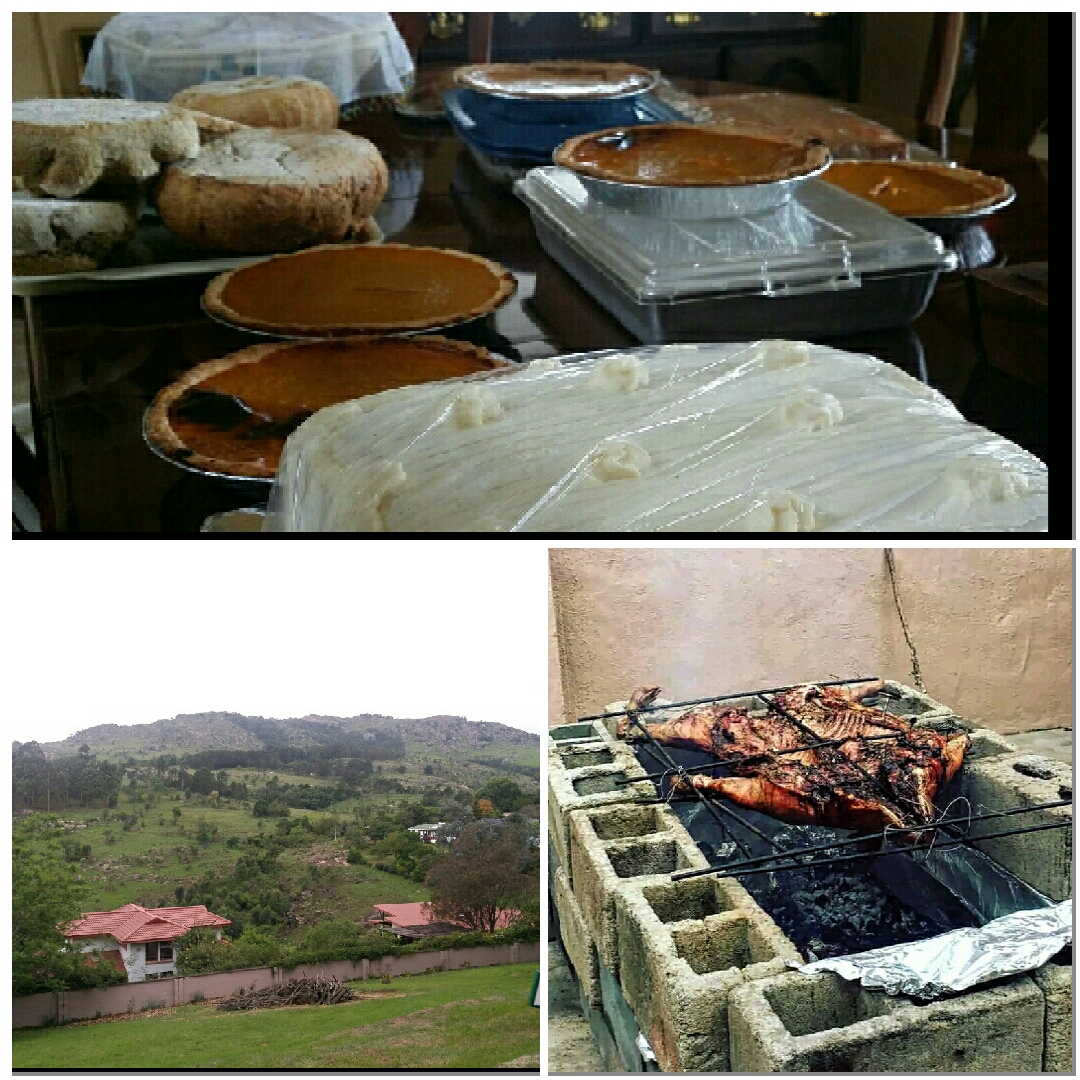
This past Thursday was Thanksgiving, an American holiday of food, family, and football. For those who may not know, Thanksgiving isn’t celebrated here in Swaziland. It’s simply another Thursday in November. For the occasion, our country director invited all of the volunteers in Swaziland to her beautiful home for a momentous feast. I wasn’t able to get pictures of all of the food, but the above collage is a bit of what our eyes and tastebuds enjoyed on Thursday afternoon. 

While the chefs were putting the final touches on the meal, I was able to relax by the pool and chat with other volunteers. There was also badminton and other backyard games to be played. This was definitely the first Thanksgiving that I was able to chill in a pool and soak up some sun. I could used to Thanksgiving as a summer holiday. 

Several volunteers and staff helped prepare various delicious dishes. It was indeed, a feast. There were four turkeys (two baked, two fried), a roasted pig, and a sizeable salmon. We enjoyed several types of stuffing, macaroni and cheese, fried cabbage, mashed potatoes, candied yams, green bean casserole and more. There were appetizers to whet our palettes, and desserts to satisfy the most distinguishing sweet tooth. 

I have a newfound respect and admiration for those who host large holiday gatherings at their home. There were more than 70 of us. There were dietary restrictions and food allergies to be observed, but there was still something for everyone. 

I wanted to take this opportunity to publicly give thanks and gratitude to our country director for hosting us in her home (and for taking suggestions on the menu); all of the volunteers here in Swaziland, for being a supportive and amazing group of folks; all of the chefs who made the meal magical; and my brother and uncle, for WhatsApping me their Thanksgiving greetings. 

Be kind to yourself. 
Onward. 

​Monday in a Picture – The Shirt Off His Back 

This past Saturday, I went to a basketball game in one of the major hubs of Swaziland, Manzini. Some ladies I know were playing in a women’s game, and I wanted to support. Though my team lost, the game was competitive and exciting. It was also good to be at a familiar sporting event. (While I vaguely understand soccer, I don’t follow it nearly as much.)

After the game, I was chatting with friends outside when I saw a guy wearing a tee shirt. Spoiler alert: it’s the shirt seen above. I approached him, and told him that I liked his shirt. He thanked me, and told me that it was an extra large. I thought nothing of him telling me the size until he started taking off the shirt. He handed it to me. I told him that he didn’t have to give me his shirt. He insisted. I thanked him repeatedly, and we embraced. He smiled, and told me that he wanted me to enjoy my time in Swaziland. 

I couldn’t stop smiling. I felt so much love. To feel that connection was so amazing. 

Be kind to yourself. 
Onward. 

​Monday in a Picture – Plowing and Planting 

Everything in life has seasons. Election season in the US is over. American football season is in its prime, while basketball season is just starting. Right now, Swaziland is heading into summer, which is the rainy season. Warm temperatures and rain mean that it’s time to plow and plant. 
The staple crop in Swaziland is umbila (pronounced om-bee-la), or maize. The staple food is liphaleshi (pronounced lee-pa-lee-she), or porridge, which is made from ground maize meal. In my community, all homesteads have some land set aside for crop farming. Many of these families will grow substantial portions of their needed maize during the summer months. Some families may even have extra to sell. But before any growing can be done, the fields have to be readied. This includes plowing the field(s), which is sometimes done by hand with a hoe, shovel, or pick. It can also be done with a tractor pulled plow (as seen in the picture above). 

I spoke with these guys for a bit. They told me that this was a prime season to make money for their respective families. You can hire these guys to plow your field (assuming you live close by). I learned that they work all day, literally. They start working around 4:00 a.m., and work until 7 or 8:00 p.m. That’s a laborious workday that starts before the sun rises, and ends after it sets. They told me not to worry because they had a light on the tractor for working in the dark.  The conversation was brief because there were fields to be plowed and money to be made. Before they left, the driver asked if I could take his picture. Wish granted. 

Be kind to yourself. 
Onward. 

​Monday in a Picture – Creepy crawlies 

When I’ve perused various forums and blogs, I noticed that one big concern for some future PCVs and those considering Peace Corps is bugs. There’s the “but what do I do if there’s a (insert scary bug here)” question. I hadn’t given much thought to my own possible reaction. That is until this past Friday. 

I was sitting on my porch enjoying a nice, early summer Friday evening when I noticed something. A spider. To be fair, I’ve seen spiders before. I saw them as a young boy and occasionally in my adult life. I’ve encountered spiders and other things (lizards, flying insects, etc.) inside my home here in Swaziland. This spider was different. It is the biggest and hairiest spider I’ve ever seen in real life. Suddenly, my Friday evening arrives at a decision point. Do I:

A. Kill the spider? 

B. Name the spider and keep it as a pet? 

C. Redirect or relocate the spider? 

D. Go inside? 

E. Do nothing? 

If you guessed (D.), you would be correct. I have no idea what kind of spider it is, whether it bites, or its overall danger. The spider seemed to be having a fine Friday evening. I wouldn’t want to ruin the spider’s evening because I didn’t want to share the great outdoors. Live and let live. 

Be kind to yourself. 
Onward. 

P.S. – if you didn’t do it early (and you’re eligible), be sure to vote tomorrow! #DCStatehood