Monday in a Picture – Umhlanga

While today is Labor Day in the US, we’re celebrating a different public holiday in Swaziland. Today is the public holiday of Umhlanga (pronounced oom-shlan-ga), which directly translates into reeds. The cultural event is also known as the Reed Dance. 

While today is the public holiday, the event started last week with the participants registering on Tuesday. Participation is only open to girls and young women who are unmarried and childless. A friend and fellow volunteer here in Swaziland is participating in Umhlanga. You can read more about her participation on her blog. I have learned more about the history, tradition, and logistics of the event as I have documented her participation. 

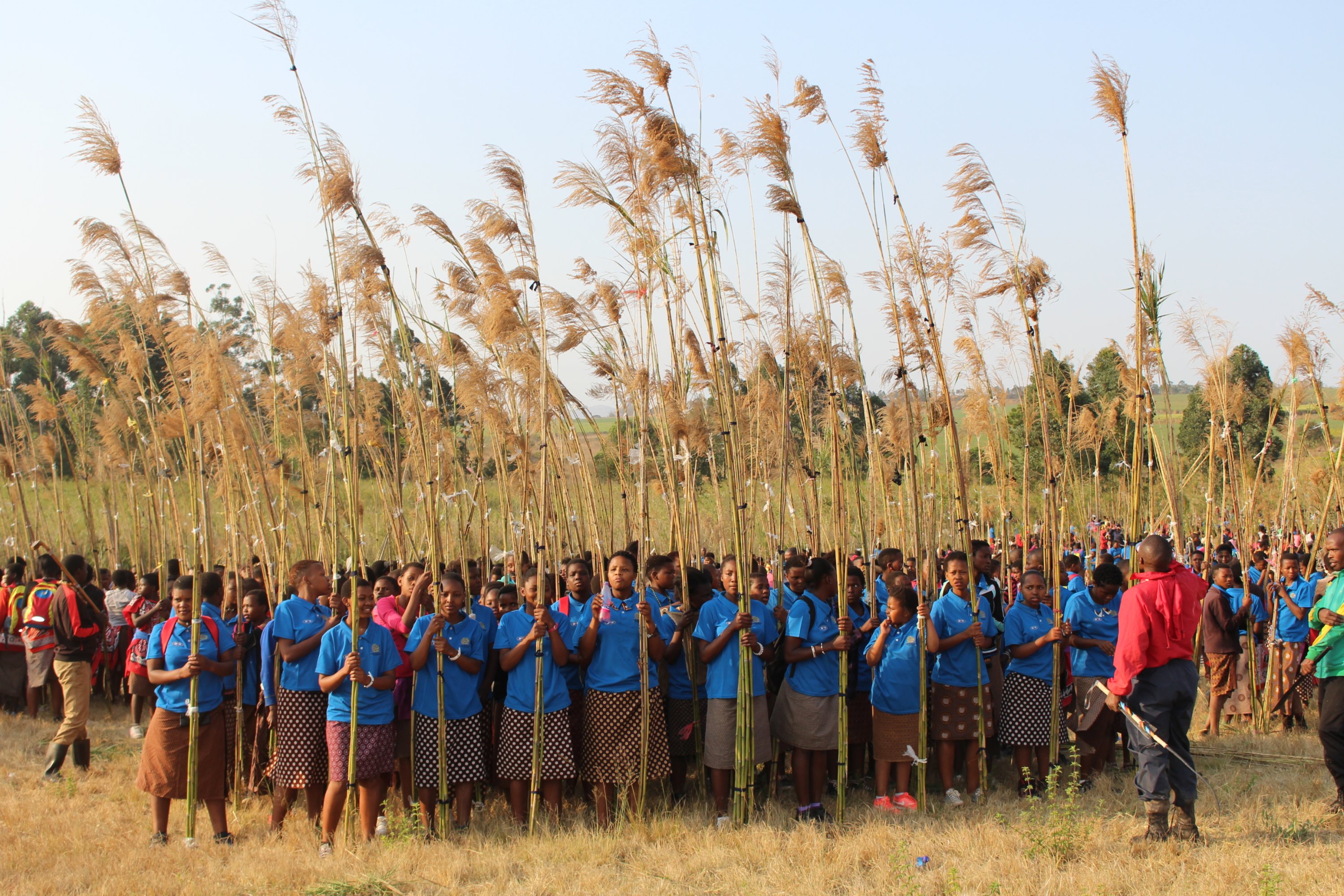
Last Thursday, the timbali (pronounced tim-bah-lee), which means maidens (and flowers), went to two specified places in Swaziland to cut reeds. Several princesses from the royal residences (who are also timbali) led tens of thousands on a march to the reeds before cutting the first reeds. The reeds were delivered to the queen mother yesterday. Today, the king and general public will watch 80000 maidens do a traditional dance meant to showcase their chastity. 

The above picture was taken as the timbali were preparing to march after cutting the reeds on Thursday. 

Be kind to yourself. 
Onward. 

Ever wonder what is Kirby doing? Follow the blog!

Monday in a Picture – Swazi Tradition

Last week, Peace Corps Swaziland swore in a new group of volunteers. It was the fifteenth installation of volunteers in the Community Health sector, and the seventh installation of volunteers in the Youth Development sector. The swearing-in ceremony itself is full of pomp and circumstance, with the US ambassador, members of the royal family, and other dignitaries in attendance. 

The evening of swearing-in day plays host to a different tradition. In Swaziland, PCVs (from all cohorts) and friends gather for a night of dancing, merriment, and fellowship at a local bar, aptly named The Pub and Grill. This tradition has been a part of festivities in Swaziland since G10 became volunteers in 2012. 

The above animation is of PCVs and friends dancing the night away last week to one of my favorite Swazi DJs, DJ Mkay.

Congratulations to the newly sworn in volunteers! 

Onward. 
Be kind to yourself. 

Ever wonder what is Kirby doing? Follow the blog!

Monday in a Picture – The Origin of Coffee

I stopped drinking coffee regularly years ago. As I got older, my digestive system grew less tolerant. I decided to limit my intake to special occasions. Being in Ethiopia qualifies as a special occasion. 

There are two things many Ethiopians were happy to tell me. First, Ethiopia is the only country on the African continent to never be colonized. Second, coffee’s origins and the best coffee is found in Ethiopia. 

There are big coffee shops that reminded me of Starbucks, aesthetically. There are small coffee shops that were described to me as micro enterprises. In both coffee shop experiences, the raw coffee beans are roasted and grinded on site. There is incense burning. The coffee is typically made over a wood burning fire in a black clay pot. There have also been instances where I’ve been offered coffee when visiting someone’s residence. 

I am happy to report that my digestive system handled the delicious coffee very well. I haven’t tasted coffee from the various coffee regions around the world, so I can’t say if Ethiopian coffee is the best in the world. I can definitively say that I have enjoyed every cup during my time in Ethiopia. 

The above picture is of a small enterprise entrepreneur named Desta pouring a cup of coffee at her street side coffee shop. 

Be kind to yourself. 
Onward. 

P.S. – Last week, I learned that Hawaii is the only US state that grows. 

Ever wonder what is Kirby doing? Follow the blog!

Monday in a Picture – Sibebe

Guest post note: As I don’t drink alcohol, I am not able to authentically speak about the beer culture here in Swaziland. In the interest of sharing as much Swazi culture as possible, fellow Peace Corps Swaziland volunteer and G14 brother Nick McDerrah wrote this guest post. Be sure to check out he and his wife’s blog here.

Sibebe is the pride of the nation, and the only respectable beer to drink on a Swazi bus or khombi. Named after a large chunk of rock near Mbabane, Sibebe is the only widely available Swazi produced beer. People may drink Castle or Hansa (two South African beers) but if you want to show pride in the beautiful country of Swaziland, grab a Sibebe. The beer is available in a variety of formats, but the proper way to enjoy this lager is through a large 660ml bottle. One of these bottles will set you back about e15, which makes it a bargain to drink local and support a Swazi enterprise. The larger bottles are also recycled and reused. It’s the beer that keeps on giving!

After interviewing others about the exact taste of Sibebe, I received responses like “it’s better than nothing,” or “tastes like piss water.” Opinions differ and obviously one beer can’t make everyone happy, but with limited beer options in country, you take what you can get. With that being said, I do believe that Sibebe is a refreshing, smooth, light beer that tastes great on a hot Swazi day. Add in a fresh squeezed lemon and you have just entered flavortown!

The taste is similar to PBR or Coors, but I believe it improves on these American classics. It also has an alcohol level of 4.8%, which is similar to other beers in this category. The bottle is a piece of art, with a gold wrapping around the rim and a nice drawing of Sibebe Rock on the label.

The ideal pairing for a Sibebe is a lunch of ‘chicken dust’ or any other braiied meats and pap. Bring some to share for your next braii and you will be the man/woman of the hour!

Sibebe is a uniquely Swazi beer that embodies the relaxed, fun loving nature of the people that drink it. It may not differ from many other cheap beers around the world, but you will be glad you tried this Swazi masterpiece.

Be kind to yourself.
Onward.

P.S.- Sibebe is pronounced sih-bay-bay.

Ever wonder what is Kirby doing? Follow the blog!

Monday in a Picture – Imali 

It’s said that the best things in life are free. For the things that have cost attached, there’s some form of currency. In Swaziland, cash is king. While some people have bank accounts and access to credit cards, this is not super common especially in more rural parts of the country. 

Swaziland’s currency is known as the lilangeni (pronounced lee-lon-gay-knee) for a singular unit, while multiple units are called emalangeni (pronounced eh-mah-lon-gay-knee). Prices in emalangeni would be expressed as E10 for something costing ten emalangeni

Swaziland’s Central Bank has authorized two different currencies to be used in the country. In addition to the emalangeni, the South African rand is also used. While both currency’s notes are used indiscriminately, rand coins are rarely accepted outside of border communities. The emalangeni and rand both come in note denominations of 10, 20, 50, 100, and 200. Both currencies also use different colors for the different denominations. While all South African rand notes feature a picture of former president, Nelson Mandela, Swaziland’s emalangeni notes feature King Mswati III. Prior to Mswati’s ascension to the throne, Swazi notes featured King Sobhuza. 

In the picture above, there are current notes (of 20 unit denomination) from Swaziland, South Africa, and United States. 

Be kind to yourself. 
Onward. 

P.S. – Imali (pronounced ee-mah-lee) means money. 

Ever wonder what is Kirby doing? Follow the blog!

Monday in a Picture – Half Dollar

Living in Swaziland has taught me many things, and reaffirmed others. One of the things that has been reaffirmed is the heavy influence of American culture on Swaziland. In particular, American hip hop culture influences many across the kingdom.

Some of my students want to know my personal familiarity and acquaintance with John Cena, Beyonce, and Rick Ross among others. I’ve helped friends in my community to get updated music from their favorite artists. 

Just outside of the Swazi metropolis known as Manzini, there is a town called Matsapha. While Matsapha is home to an array of businesses and restaurants, one business meshes American hip hop culture and Swazi cuisine. The eatery’s name is 50’s Kitchen. The restaurateur is definitely 50 Cents’ doppelganger. But he doesn’t rest on his resemblance to his famed American twin to garner business. The food is delicious and affordable. 

If you ever find yourself in Matsapha, or even Manzini, definitely stop by and enjoy the culinary delights. 

Be kind to yourself. 
Onward. 

Ever wonder what is Kirby doing? Follow the blog!
Monday in a Picture – Seasoned with Experience

​Last week, I was fortunate to co-facilitate a session during PST for G15. It was the second session I’ve co-facilitated for the new group. Shortly after the session, I came to the realization that I’m now a part of the seasoned group of volunteers in Peace Corps Swaziland. I’m a part of the group of volunteers with a year of experience. At times, training staff will ask volunteers to assist with sessions for trainees. 

To date, I have co-facilitated a session on Diversity and Inclusion, and another session on Being Black in Swaziland. Feedback has been generally positive. The above photo was taken by Karlene. 

Be kind to yourself. 
Onward. 

Ever wonder what is Kirby doing? Follow the blog!